
AI is rapidly reshaping the hydrocarbon sector, from exploration and drilling to transportation, refining and asset management. Under constant pressure to do more with less, operators are looking to scale AI to optimize operations across increasingly complex and remote environments.
But many organizations are discovering that AI alone isn’t enough.
AI is only as effective as the operational data it receives—and how quickly it can turn that data into action. Without reliable, real-time connectivity, even the most advanced AI models can be limited by delayed, incomplete, or inconsistent information.
As aging infrastructure, unplanned downtime, and workforce pressures intensify, operators are under growing pressure to improve reliability while reducing operational risk and emissions. This is accelerating the shift from reactive maintenance toward predictive, condition-based operations powered by AI and industrial IoT.
For many oil and gas environments, particularly remote sites, offshore platforms and distributed pipeline networks, traditional connectivity infrastructure can struggle to support the scale, responsiveness and resilience required for real-time operational intelligence. As AI goes beyond analytics to support real-time decision-making and increasingly autonomous operations, connectivity is becoming a strategic operational capability rather than simply part of the IT infrastructure.
Private 5G is increasingly helping address these challenges by delivering reliable, low-latency connectivity for high volumes of sensor data while keeping sensitive operational traffic secure and local. By creating a secure, resilient foundation for AI and industrial IoT, it supports applications such as predictive maintenance, drone inspections and connected workers—helping operators improve safety, reduce downtime, and make faster, data-driven decisions.
AI adoption is accelerating across oil and gas
The momentum behind AI is no longer theoretical. Across the oil and gas industry, organizations are already investing heavily in AI, IoT, robotics, and cloud technologies to improve efficiency, resilience, and asset performance.
GlobalData’s Q1 2026 surveys showed more than half of respondents identified technologies such as AI, IoT, robotics, and cloud computing as ‘disruptive’ to the industry. Almost 60% of respondents said they expected to increase investment in digital tech over the next year, with autonomous (Agentic) AI attracting significant interest. Figures from GlobalData confirm that the total AI market is expected to be worth around US$910 billion in 2030, up from just $81 billion in 2022[i].
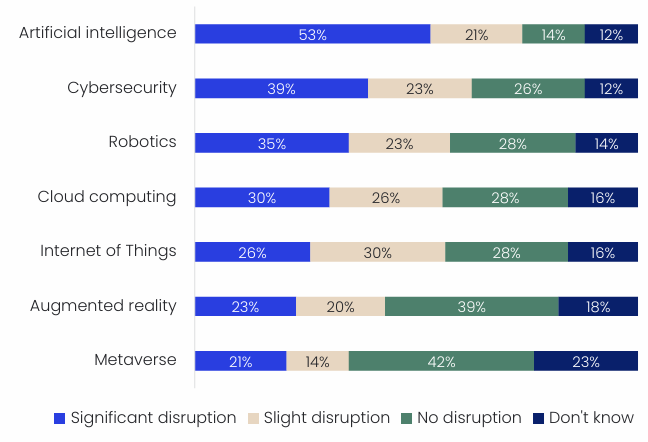
The findings suggest the conversation has shifted from whether organizations should invest in AI to how they can successfully deploy it at scale. Historically, AI in industrial environments has largely focused on diagnostics and optimisation. The next phase involves embedding intelligence directly into operational systems, enabling machines, infrastructure, and field operations to become increasingly adaptive and autonomous.
As AI becomes embedded in operational workflows, connectivity moves from supporting operations to enabling them.
Technologies such as digital twins, edge computing and Physical AI depend on the ability to move large volumes of operational data securely and with minimal delay, particularly in environments where responsiveness directly affects safety, uptime, and operational continuity.
Barriers to scaling AI
While AI is creating significant opportunities across oil and gas, scaling deployment remains complex. Operators must comply with stringent safety and environmental requirements while navigating evolving local and international regulations. For multinational organizations, maintaining compliance across multiple jurisdictions often requires significant investment in governance, assurance processes, and specialist expertise.
Many operators are also working with aging operational technology (OT) environments that were never designed to support today’s connected assets or AI-driven decision-making. Modernizing infrastructure while maintaining continuous operations adds another layer of complexity to large-scale AI deployments.
Integrating AI into existing systems presents another challenge. AI relies on large volumes of trusted, high-quality data, yet that data is often fragmented across organizational silos and legacy systems, making it difficult to consolidate and analyse effectively. While connectivity alone does not remove these silos, private 5G can reduce friction in collecting consistent data and support stronger data governance through secure network segmentation.
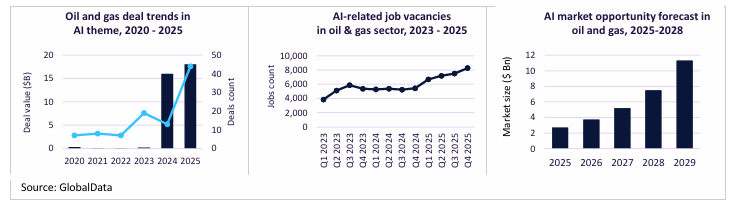
Despite these operational and regulatory challenges, momentum behind AI continues to accelerate across the industry. Oil and gas is still primed to adopt AI capabilities across its entire value chain, with the sector expected to move quickly from diagnostic to Agentic AI, as shown by trend analysis by GlobalData[ii].
Such AI systems not only analyse data but also execute complex actions themselves, for example, automatically adjusting drilling parameters, thus accelerating the shift in workforce skills from manual tasks to digital oversight. Agentic AI depends on reliable, low-latency private 5G connectivity to support human-in-the-loop controls, safety interlocks and system-wide observability.
In action: AI and predictive maintenance in energy
These capabilities are supporting a broad range of use cases for AI and predictive maintenance that span the entire energy value chain, enhancing business activity through numerous phases of the product’s lifecycle:
Upstream. Here, AI can enhance extraction by optimising modelling, drilling and well performance, while Machine Learning models analyse subsurface data to identify promising reservoirs and refine well placement. During drilling, AI can adjust parameters such as weight on bit, mud flow, and rotation speed in near real time, avoiding equipment damage.
Once wells are producing, AI monitors equipment for early signs of degradation, such as abnormal pressure and flow patterns, vibration changes, temperature drift, or declining performance. This enables predictive, condition-based maintenance so operators can intervene quickly, as well as helping to reduce unplanned downtime, improve safety through earlier detection of hazardous conditions, and support asset life extension and ESG goals by cutting waste, energy use, and emissions.
Private 5G further strengthens predictive maintenance by supporting dense sensor coverage, secure mobility, and real-time data transmission to edge and cloud analytics—helping operators reduce downtime, extend asset life, and improve worker safety.
Midstream. AI is playing a key role in maintaining the integrity and availability of pipelines, terminals, and storage facilities. For example, IoT sensors placed along pipelines and at pumping stations feed continuous data on pressure, flow and temperature into AI models that can spot subtle anomalies, such as small leaks, corrosion, or unauthorised interference.
For rotating and high-duty equipment such as compressors, pumps and valves, AI combines sensor data with historical failure patterns to anticipate faults before they become outages, reducing the likelihood of safety events, product loss, and rogue emissions, while also allowing maintenance to be scheduled when it causes the least disruption. Reliable connectivity ensures these insights are delivered in time for operators to act before small issues become major operational or environmental events.
Downstream. In refineries and petrochemical plants, AI models can fine-tune process conditions to maximise yield and efficiency, while predictive analytics can identify early signs of fouling, catalyst degradation, or heat exchanger problems. AI also supports accurate demand forecasting and inventory management, reducing unnecessary stock movements. These condition-based interventions improve operational efficiency while helping extend asset life, reduce maintenance costs, and support evolving ESG and compliance objectives.
Together, these capabilities turn AI into a powerful intelligence layer across operations, transforming raw data into actionable insight and helping companies get more value from both new and legacy assets.
Enabling AI-driven operations at scale
As AI adoption accelerates across oil and gas, the industry’s competitive advantage will increasingly depend on how effectively operators can turn operational data into real-time action. That needs more than AI models alone, with connectivity infrastructure capable of supporting secure, resilient, and intelligent operations at an industrial scale.
Ericsson’s private 5G capabilities provide a strong foundation for AI-enabled predictive maintenance by supporting dense sensor networks and secure, low-latency data flows across assets. It is designed to operate in harsh environments and integrate with existing workflows, safety systems, and operational processes, rather than sit apart as a standalone telecom upgrade.
With local routing and edge processing, Ericsson’s solution allows AI workloads to run closer to the equipment they monitor, reducing latency and backhaul costs, while its deterministic connectivity turns data from machines, people, and processes into trusted inputs for decisions. It also supports large-scale device deployments with quality of service for critical traffic and strengthens cyber resilience through network segmentation and granular control of data flows.
As private 5G evolves from a communications upgrade into a foundational layer for AI-driven operations, a provider that offers simplified solutions packaged according to specific requirements and infrastructure, alongside the necessary support and training, is critical to successful deployment.
For more information on how your operation could benefit from private 5G and why connected environments are now a foundational requirement rather than a discretionary technology upgrade, download the free paper below.
[i] GlobalData: Artificial Intelligence in Energy, August 2023
[ii] GlobalData: Top 20 Oil & Gas Themes 2026, April 2026