

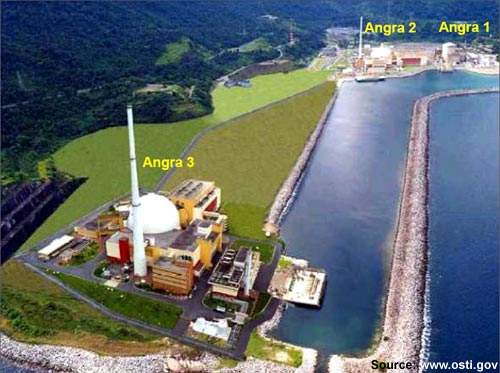
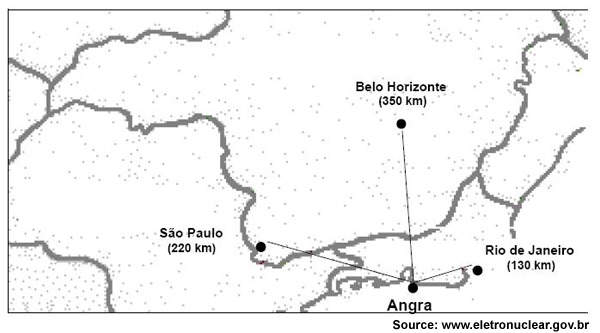
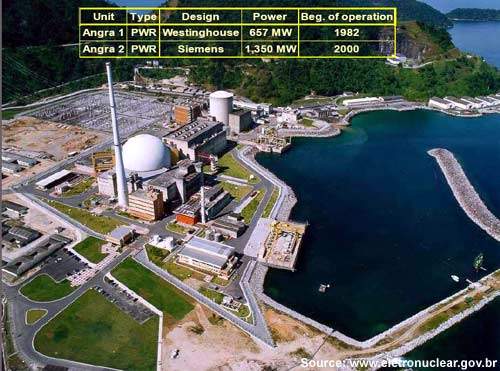
The 1,405MWe Angra-3 PWR nuclear reactor project is on again. The Brazilian Government has announced plans to complete the reactor, which will work alongside the other two at Angra, which is between Rio de Janeiro and Sao Paulo. The project is estimated to cost $5.6bn and is scheduled for completion in 2018. A total of $327m was already spent during the early phase of development of Angra-3.
Angra-3 was designed to be a twin of the four-loop Angra-2, but was halted in the mid-1980s after lack of funding. Construction officially restarted in June 2010 after the approval of a return-to-construction by Brazil’s National Energy Policy Council in June 2007. Presidential approval for the same was received a month later, in July.
Recommended Buyers Guides

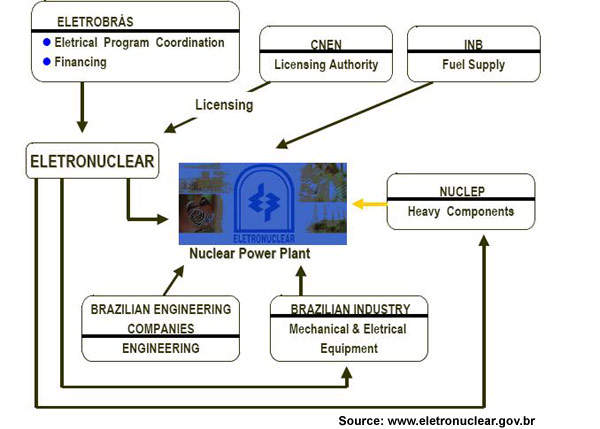
The main shareholder in the Brazilian nuclear utility Eletronuclear and partially owned by the government, Eletrobras has been looking for the required $1.8bn from a private partner to complete the project, but there has also been some interest from the Russian Government.
In December 2010, the project received a financial boost when the Brazilian national development bank BNDES approved a $3.6bn loan, covering approximately 59% of the total cost. The loan is for 20 years with a grace period of five years.
Angra-1 and Angra-2 are now producing 630 and 1,270MWe respectively. Angra-1 had to be shut down early after problems with its steam supply system.
The World Nuclear Association reports it had a load factor of only 25% over the first 15 years of operation, but has greatly improved since then. The Brazilian Government has announced plans to build another four 1,000MWe reactors from 2015, with a total of up to 8GWe by 2030.
Government announces go-ahead for Angra-3
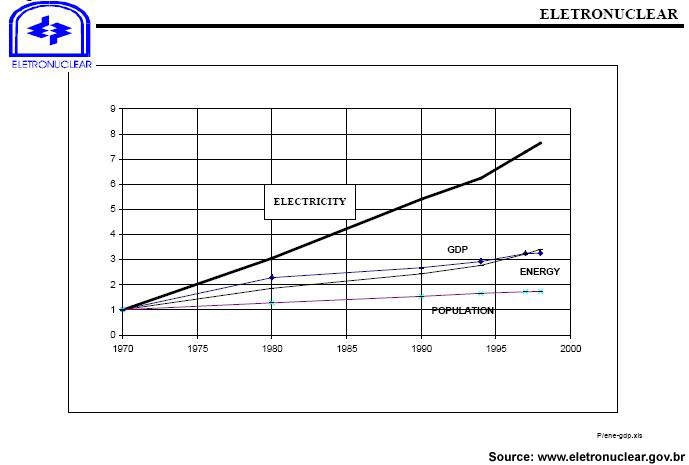
Brazil’s electricity consumption has been growing strongly over the last 15 years. Although droughts have caused power shortages, hydroelectric provides more than 80% of the total energy generated with nuclear at less than 5%. Approximately 40% of the total is produced by Eletrobras.
The turnkey Angra-1 was built by Westinghouse, starting in 1971 and coming on stream in 1982. In 1976 the Brazilian Government signed an agreement with West Germany for eight 1,300MWe nuclear units, to be built by 1990. Siemens-KWU built the first two plants, with a technology transfer agreement aiming to build the rest with 90% Brazilian content.
The projects were however suspended. Eletrobras took over responsibility for building Angra-2 and Angra-3, and in 1995 started construction at Angra-2 again. Eletrobra and German banks provided $1.3bn of funding, and Angra-2 was completed in 2000.
Angra-3 is a PWR, so a second-generation reactor using high-pressure superheated water as coolant and neutron moderator. PWRs are the world’s most-used type of reactor. The chain reaction in the nuclear fuel heats water in the primary to over 300ºC, with the hot water pumped into a steam generator or heat exchanger to boil water in the secondary coolant loop, which drives a steam turbine. The primary and secondary coolant loops keep radioactive water in the first loop separate from that used to drive the steam generator.
Serviced by Framatome
Framatome ANP performed service work at Angra-2 in March 2002, during the first of the annual refuelling outages. Work was done on the reactor floor, fuel assemblies, valves, pumps and pump motors. Framatome also inspected the emergency diesel generating units, electrical and I&C systems, HVAC systems and reactor coolant pumps.
The inspection work by more than 1,000 engineers was done in less than 30 days with Eletrobràs Termonuclear (Eletronuclear) and German and Brazilian subcontractors.
Angra-3 construction
Eletrobras Termonuclear signed a contract with design and consultancy firm ARCADIS Logos in May 2014 for engineering consulting services for the development of Angra-3. ARCADIS will deploy 70 professionals to work on-site at Angra-3 to monitor the execution, inspection and testing of the electromechanical constructions and civil works of the plant over a period of 36 months.
In February 2014, Eletrobras Eletronuclear awarded contracts worth $1.5bn to two competing consortia of construction and engineering companies for the electromechanical assembly of Angra-3. UNA 3, a consortium formed by Andrade Gutierrez, Norberto Odebrecht, Camargo Correa and UTC Engenharia, will assemble the plant’s conventional systems for $640m, while another consortium called Angra 3 formed by Queiroz Galvão, EBE and Techint will build the primary circuit under an $830m contract.
Areva was awarded a $1.67bn contract in November 2013 to provide engineering services and components for the Angra-3 plant. The contractual scope also includes providing digital instrumentation and control system for the reactor, in addition to assistance to supervise the installation and commissioning.
More than 5% of world’s total uranium deposits
Brazil has more than 5% of the total world uranium deposits, with roughly 230,000t, although only INB’s Lagoa Real Unit mine is now working. The uranium is converted and enriched abroad and then used in Brazil but some of Angra’s fuel is now produced by Brazilian centrifuges.
In 2006, Brazil opened a new centrifuge facility at the Resende nuclear plant, claimed to be 25 times more efficient than French and US facilities. The government said it hoped to meet all its nuclear energy needs within a decade. The centrifuges were subject of some discussions with the International Atomic Energy Agency, with safeguards to ensure there will be no links to weapons production.
