

The addition of 60 turbines to the existing 62.5MW Crystal Rig wind farm in East Lothian, Scotland, was completed in the third quarter of 2010. The second phase of expansion to the plant was divided into Crystal Rig IIa (nine turbines) and Crystal Rig Phase II (52 turbines).
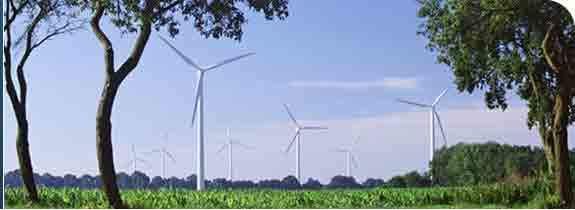
The wind farm now operates with 85 wind turbines (25 turbines of Phase I and Ia, and 60 of Phase II and IIa) giving it a nameplate capacity of 200.5MW. The facility is operated by Natural Power and is owned by Fred Olsen Renewables (FORL).
Recommended Buyers Guides

The third phase of expansion known as Crystal Rig III has been assessed for development. The proposed expansion will be situated on the northern side of Crystal Rig IIa and involve installation of 9 to 18 turbines, anemometer masts and laying of internal tracks and access roads.
The wind farm, the second largest on land in the UK, sits within a large landscape hidden from the surrounding countryside. It won the 2004 Best Renewable Project prize in the Green Energy Awards, and shows how large machines can be deployed without visual impact.
The Crystal Rig wind farm is about 11km south of Dunbar and 16.5km north-west of Duns. It is within the Scottish Borders Council area, and near to the border of the East Lothian Council area. It lies within an area of commercial forestry on high ground within the Lammamuir Hills.
Natural Power Consultants (NPC) selected the site and performed wind engineering, site design, development management and onsite construction
Crystal Rig capacity rises from 50MW to 200.5MW
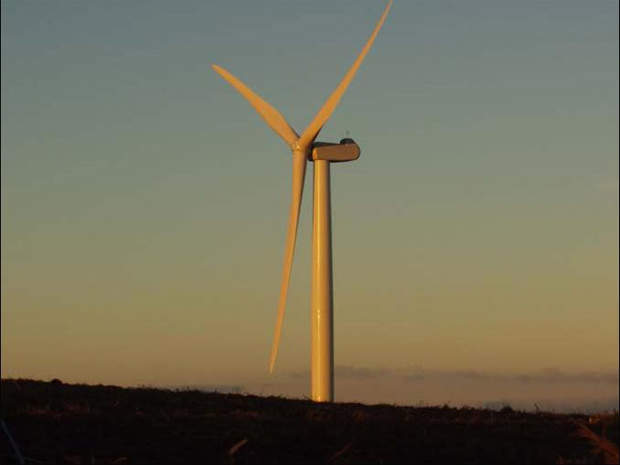
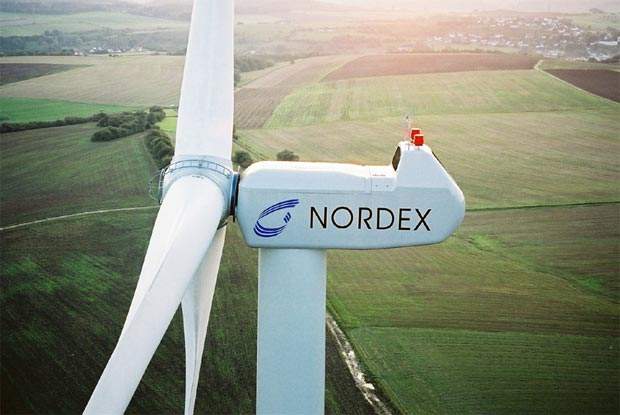
The project uses Nordex N80 2.5MW wind turbines. It also includes associated wind turbine transformers and housings, site tracks and foundations, up to two anemometry masts, switch gear, metering building and associated works, and cabling and ducting.
The original proposal, for 25 turbines generating 49MW, received planning permission in June 2002 from Scottish Borders Council. Larger capacity turbines came available with the same physical dimensions (below 100m high from base to tip) but a total capacity of 62.5MW.
However, wind farm applications with above 50MW capacity need to be approved by the Scottish Minister. The developer was therefore only able to construct 20 of the 25 turbines. On 18 November 2003, the wind farm applied to the Scottish Ministers for consent to build the remaining five turbines. These were commissioned in 2005.
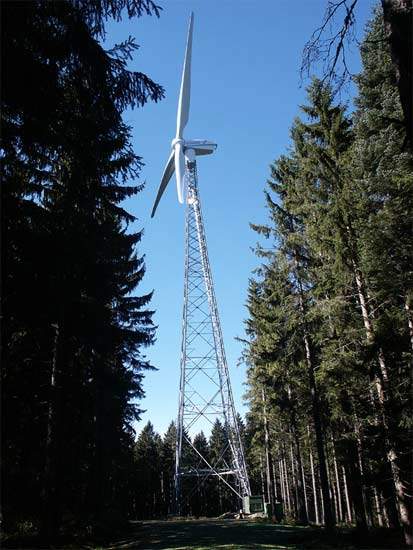
The project involved clearing a large area of poor conifer plantation, which actually enhanced the wildlife habitat in the area. NPC has also committed six years of ornithological monitoring. It has to do this annually for three years following commissioning, and then at five, ten and 15 years thereafter.
The capacity was increased by 138MW as part of Phase II and Phase IIa between 2007 and 2010.
Wind design and optimisation software at Crystal Rig
NPC used WindFarmer wind farm design and optimisation software to perform wake modelling exercises and energy yield predictions. Wind flow modelling uses the industry standard WAsP wind flow analysis model, and the company is one of the few qualified WAsP users in the UK.
It participates in studies to test and verify 3D wind flow models in areas of highly complex terrain, where the opportunity to use WAsP, or other simple linear flow models is limited.
Wind analysis services include site anemometry, wind data analysis and regime prediction, and wind flow modelling. Energy yield predictions include full uncertainty analysis, and NPC helps with securing planning permission for masts, equipment specification and procurement, and mast site selection and installation.
80M rotor diameter
The N80 has a rotor diameter of 80m. Pitch control optimises the energy yield at all wind speeds. The machine offers low maintenance: there are no rotating hydraulics in the hub, the blade adjustment drives are maintenance free, and control cabinets are easily accessible.
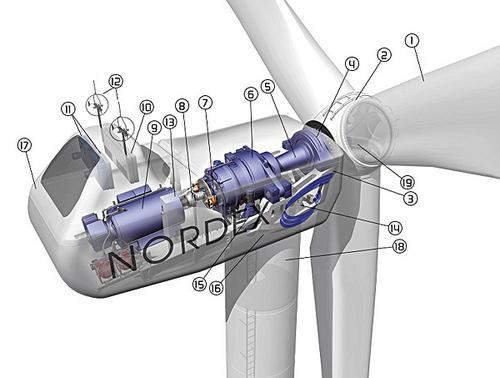
The rotor blades (1) are made of glass fibre-reinforced plastic, with a pitch-regulated rotor. The hub (2) is made of cast iron, and the turbine frame (3) is ductile cast iron. The solid double spherical rotor bearing (4) has a ductile cast iron casing. The rotor shaft (5) is also made of ductile cast iron.
The gearbox (6) is a custom-designed two-stage planetary gear. The disk brake (7) has two brake callipers and is located on the high-speed shaft of the gearbox. The generator coupling (8) is a flexible coupling, with a 2,500kW liquid-cooled double-fed asynchronous generator (9). The cooling radiator (10) is a part of the gearbox cooling system, with fan coolers (11) cooling the generator.
The wind-measuring system (12) consists of a redundant anemometer and wind vane, measuring the wind conditions and passing the signal to the turbine control system (13). This monitors and controls the turbine. The hydraulic system (14) maintains and controls the hydraulic pressure to the disc brakes and the yaw brake system.
The yaw drive (15) has two planetary yaw gears, driven by frequency-controlled electrical motors. The yaw bearing (16) is a four-point ball bearing with outer teething. In addition, the turbine has an active yaw disc brake system.
The nacelle cover (17) is made of glass fibre-reinforced plastic on a steel frame, while the tower (18) is a tubular steel structure available in various heights. The pitch system (19) consists of three independent pitch gears, driven by electrical motors.
Wind power grows in Scotland
The addition of new turbines helped Scotland meet its target to generate 31% of electricity from renewable sources by 2011.
A considerable number of community and householder projects have also been brought into operation throughout Scotland in the recent past. Projects like these will help improve the percentage of energy produced by renewables in Scotland from today’s 31% to 100% by 2020.
