

The Lagisza Power Plant is the world’s first supercritical circulating fluidised bed (CFB) project at Lagisza, in Poland.
Valued at €150m, the project covers a 460MWe boiler island for a power plant at Lagisza. Work started at the site in February 2006 and the project was commissioned in June 2009.
Recommended White Papers

Recommended Buyers Guides

The plant is owned by Poland’s largest utility, Poludniowy Koncern Energetyczny (PKE). It is the world’s first once-through unit (OTU) and also the largest energy-sector investment to be financed without being guaranteed by long-term contracts.
PKE used its own capital, state funds and several Polish environmental protection funds to construct the plant, which generates 18% of the power and 16% of heat produced in Poland.
PKE negotiated with Polish power grid operator PSE to access its high-voltage transmission system, allowing the company to export the power generated from the new Lagisza power block.
The new unit was built alongside PKE’s existing 840MWe power station at Lagisza (north-east of Katowice in Upper Silesia). It is part of an ongoing programme by PKE to replace outdated capacity with modern, high-efficiency plant.
Operating seven other power stations in southern and western Poland, PKE is the country’s largest electricity utility, with 5,056MW of installed generating capacity.
Foster Wheeler Energia and its Polish subsidiary Foster Wheeler Energia Polska are jointly executing the contract. Pre-engineering work started in March 2003. Notice to proceed was gained in 2003 and plant start-up should take place early in 2009.
Fluidised bed combustion
The Lagisza plant has efficient fuel usage and low emissions, fully meeting the requirements of the EU’s new large combustion plant (LCP) directive. Total plant efficiency is above 43%.
Supercritical steam cuts fuel use per GWh of electricity generated by some 5% over conventional drum-based boilers. An equivalent increase in fuel efficiency has typically taken up to ten years of cumulative developmental work to achieve, so achieving this improvement in a single step is a major achievement.
A modular design approach enables supplier Foster Wheeler to offer even larger units of the same type in the future.
Circulating fluidised beds burn many fuels cleanly, including waste coals, petroleum coke, and even shredded automobile tires. They have been installed at chemical plants, steel plants and other industrial facilities around the world.
They range in size from relatively small industrial units to large ‘utility-scale’ installations rated at hundreds of megawatts.
The low combustion temperature (~850°C) of the CFB minimises NOx and permits optimum sulphur capture, while the flywheel of circulating solids permits significant variations in fuel properties. CFB-furnace heat fluxes are also less than half those of peak heat fluxes in pulverised-coal furnaces. As a result, low mass-flow rates can be used in the furnace tubes without concern for tube overheating.
The flywheel of circulating solids also provides relatively uniform heat-absorption rates, which minimise concerns for heat absorption unbalances. Foster Wheeler, the supplier of CFB, uses a Siemens Benson vertical once-through unit (OTU).
OTU boilers amd steam flow rate control
Boilers for utility power generation are either drum or once-through types, referring to how water is circulated to cool the tubing that forms the furnace enclosure. Heat is transferred through the tubes and into the water passing through to generate steam. In drum-type units, the steam-flow rate is controlled by the fuel-firing rate.
Superheat steam temperature is determined by properly sizing the superheater heat-transfer surface, and is controlled by spraywater. In a once-through type boiler, the steam-flow rate is established by the boiler feedwater pump and the superheat steam temperature is controlled by the fuel-firing rate.
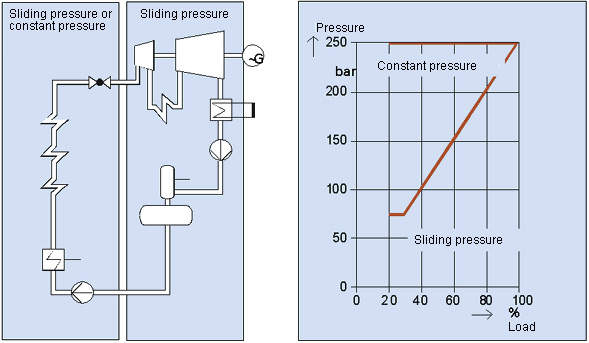
Since the once-through boiler does not rely on the density difference between steam and water to provide proper circulation and cooling of the furnace enclosure tubes, it can be operated at supercritical (more than 220bar / 3,200psia) pressures.
Greater steam-turbine efficiency then improves plant heat rates. Efficiency increases by roughly 3% on making the transition from 167bar, the standard for drum boilers, to 250bar without significant increases in investment costs.
With about 1,000 units, the Benson boiler is the most common implementation of the once-through design.
