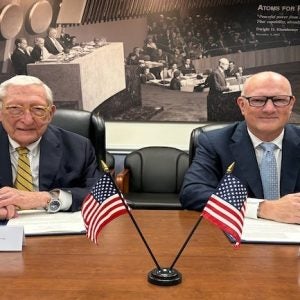
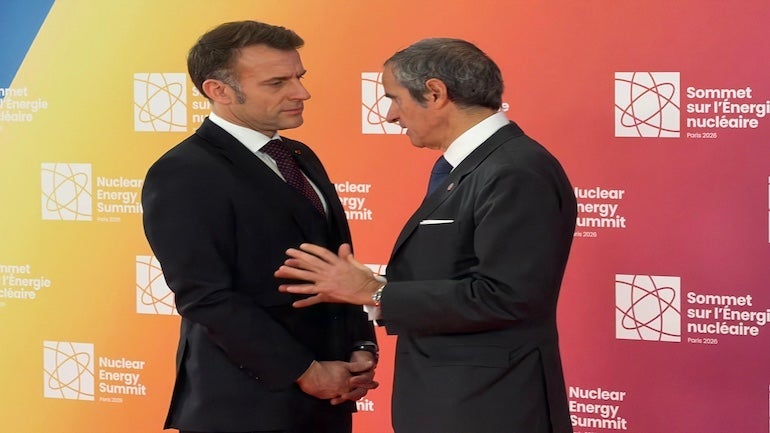
At the second World Nuclear Energy Summit (WNES) in Paris on 10 March, four additional countries – Belgium, Brazil, China and Italy – joined the Declaration to Triple Nuclear Energy first launched in 2023. This brings the total number of signatories to 38.
This year’s summit was hosted by the French Government in collaboration with the International Atomic Energy Agency (IAEA). It followed the inaugural 2024 meeting in Brussels and aimed to solidify nuclear power’s role in global decarbonisation. Heads of state and leaders from more than 60 countries discussed financing models, fuel supply security and the development of skilled workforces.

Discover B2B Marketing That Performs
Combine business intelligence and editorial excellence to reach engaged professionals across 36 leading media platforms.
Download sample pages of selected reports
Explore a selection of report samples we have handpicked for you. Get a preview of the insights inside. Download your free copy today.
Many of the world’s largest financial institutions, and best-known large users of energy – including Google, Amazon and Meta – have joined more than 140 nuclear companies in backing the governmental declaration with their own pledges of support.
Leaders at the Paris summit emphasised that meeting the goal of tripling nuclear energy by 2050 will require strong international cooperation, supportive policy frameworks and access to finance to enable the construction of new nuclear plants and the development of advanced reactor technologies.
At the summit’s opening ceremony, French President Emmanuel Macron said: “Nuclear power is a source of progress and prosperity because it is a source of energy, particularly for electricity generation, which allows us to reconcile three objectives that are central to our ambitions: we want competitiveness, that is, energy produced at the lowest possible cost; we want to solve the planet’s problems by reducing CO₂ emissions; and we want greater independence.”
He added: “We need to standardise as much as possible between countries and manufacturers – to establish standards in terms of capacity, energy producers and countries. This is key to reducing costs and delays and ensuring that nuclear power will be part of the energy transition. To this end, safety authorities must continue the work already well under way within the IAEA to harmonise safety standards.”
IAEA director general Rafael Mariano Grossi said: “Nuclear power is not simply a nice-to-have, or a cleaner option. It is a strategic opportunity and we know it. When we speak about development, we speak about electrification, digitalisation and artificial intelligence; in all these areas, we will need reliable and predictable answers. Nuclear energy is one of those answers. As the global hub of expertise across the nuclear life cycle, the IAEA will continue supporting countries as they move to seize it.”
Over the course of the day, participants explored how nuclear energy contributes to stable, low-carbon energy systems while upholding international commitments to safety, security and non-proliferation. They will examine technological pathways shaping the future of nuclear energy. These include extending the lifetime of existing reactors, constructing new large-scale plants, deploying small modular reactors (SMRs) and developing next-generation concepts that integrate advanced safety features and digital tools.
Financing remained a core topic. Governments and financial institutions examined models that support nuclear deployment in both emerging and established markets, reflecting ongoing efforts to align climate finance with long-term, low-carbon energy strategies.
“Today, around 60 countries are considering nuclear energy, but momentum alone is not enough: nuclear must be investible. Predictable policies, robust supply chains and accessible financing are essential to reduce costs and scale up its deployment, alongside greater standardisation so the industry can move toward repeatable designs,” said Grossi.
The IAEA has expanded its cooperation with international financial institutions to help countries explore and finance nuclear power plants (NPPs). These partnerships include engagement with the World Bank Group, the Asian Development Bank, the European Bank for Reconstruction and Development, the Development Bank of Latin America and the Caribbean, and the OPEC Fund for International Development.
The summit concluded with a high-level joint statement: safe and affordable nuclear energy for all. The statement calls for nuclear energy to be more broadly included in the environmental, social and governance policies of international financial institutions. Signatories pledged to support countries that are new to or currently exploring nuclear energy by sharing technical expertise and building industrial capacity. They committed to advancing technological innovation (such as SMRs) and strengthening the resilience of global nuclear supply chains.
The statement called on relevant international financial institutions “to consider developing frameworks to mobilise private capital where sovereign backing helps to mitigate early-stage risks and incentivise private finance stakeholders to participate, and we call on private actors to seize the momentum to finance these long-term, strategic energy projects”.
It committed “to fully unlocking the potential of nuclear energy by taking measures such as enabling conditions to support and remove barriers to finance the construction of new NPPs, the lifetime extension of existing nuclear reactors, and the development [and] early deployment of advanced reactors, including SMRs, worldwide while maintaining the highest levels of safety, security and non-proliferation”.
It endorsed the role of the IAEA “as key enabler for cooperation in the nuclear field, including in promoting a strong and sustainable global framework for nuclear safety and security, and verifying adherence to respective safeguards obligations”. In this regard, “we stand ready to work with the IAEA to identify and provide the necessary resources needed for the fulfilment of these objectives, subject to the availability of funds and any applicable domestic legal requirements”.
The statement was signed by Armenia, Belgium, Bulgaria, Canada, China, Croatia, the Czech Republic, the Democratic Republic of Congo, Estonia, Finland, France, Greece, Hungary, Italy, Japan, Jordan, Kazakhstan, Lithuania, Morocco, Mongolia, the Netherlands, Pakistan, Poland, Romania, Rwanda, Serbia, Slovakia, Slovenia, South Korea, Sweden, Türkiye, Ukraine, the UK and Vietnam.
Unlock up to 35% savings on GlobalData reports
Use the code at checkout in the report store
-
20% OFF
Buy 2 reports
Use code:
Bundle20
-
25% OFF
Buy 3 reports
Use code:
Bundle25
-
30% OFF
Buy 4 reports
Use code:
Bundle30
-
35% OFF
Buy 5+ reports
Use code:
Bundle35
Valid on all reports priced $995 and above. Cannot be combined with other offers.
Still deciding what will work best for your business?
Ask our experts for help.
Enquire before buying