With waste-to-energy plants finding themselves under increasing pressure to reduce carbon dioxide (CO₂) emissions, having the potential to achieve negative emissions and even become “climate positive”, carbon capture projects are proliferating.
Full scale CCS+WtE in the UK
Kanadevia Inova (formerly Hitachi Zosen Inova) has recently been given notice-to-proceed instructions by its long-term client Encyclis to build what is expected to be the first full-scale carbon capture project at a UK waste-to-energy facility.
Go deeper with GlobalData

Go deeper with GlobalData
The gold standard of business intelligence.

Download sample pages of selected reports
Explore a selection of report samples we have handpicked for you. Get a preview of the insights inside. Download your free copy today.

Discover B2B Marketing That Performs
Combine business intelligence and editorial excellence to reach engaged professionals across 36 leading media platforms.
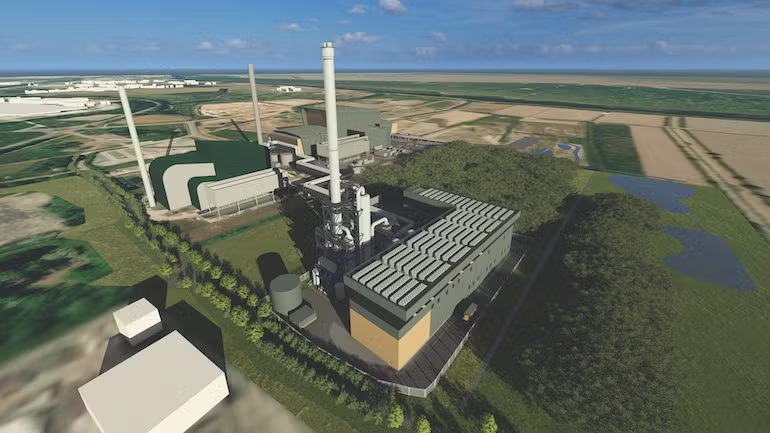
With planning and environmental permitting permissions granted, the three-and-half-year construction and commissioning programme will deliver this flagship project at the Protos Energy Recovery Facility (ERF) near Ellesmere Port, Cheshire.
Serving as the engineering, procurement and construction contractor, Kanadevia Inova will utilise its amine scrubbing technology to capture around 370,000t of CO₂ per year from one of the UK’s newest WtE facilities.
The two-line carbon capture facility will be sited immediately next to the WtE plant. It will capture a mixture of biogenic and fossil-originated CO₂ released via the combustion of non-recyclable waste at Protos ERF.
While WtE facilities are the most climate-friendly waste management option for treating non-recyclable materials, when combined with carbon capture and storage (CCS) technology, Protos ERF will become a negative emitter.
The project is part of the HyNet North West network and the captured CO₂ will be sequestered in depleted gas reservoirs under Liverpool Bay.
Full-scale capture at Protos builds on two Kanadevia Inova UK CCS pilot projects at Ferrybridge and Rookery South.
“This landmark project in the UK sits at the core of our global mission and vision,” said Fabio Dinale, executive VP of business development at Kanadevia Inova, “marking the beginning of a new era in delivering carbon capture solutions to growing markets in the UK and across the globe”.
After the three-and-a-half-year build, encompassing substantial integration works and the plant’s commissioning phases, the groundbreaking capture facility is scheduled to be handed over to Encyclis in mid-2029.
BECCS in the US
Meanwhile, in the US, AtmosClear has announced that it has selected ExxonMobil to provide CO₂ transportation and storage services for its carbon removal project at the Port of Greater Baton Rouge in Louisiana.
The ExxonMobil CCS system will be used to transport and permanently store up to 680,000t per annum of biogenic CO₂ from AtmosClear’s biomass energy with carbon capture (BECCS) facility, with the potential for additional volumes. ExxonMobil’s integrated system – including Class VI wells, existing pipelines and advanced monitoring systems – will enable “efficient, secure and cost-effective CO₂ transportation and storage” for AtmosClear’s carbon removal project, which will provide carbon dioxide removal (CDR) credits for Microsoft and other customers.

Fidelis co-founder and CEO Dan Shapiro said ExxonMobil was selected for its “extensive existing infrastructure, world-class safety culture and proven operational excellence”. The agreement is seen as a critical step towards delivering CDR credits to Microsoft under the CO₂ removal purchase agreement signed in March 2025, one of the largest CDR purchase agreements to date. “By leveraging ExxonMobil’s unmatched expertise and mature CCS systems, we can deliver high-integrity carbon removals with strong economic advantages through scalable, cost-efficient operations while ensuring the highest standards of safety and reliability.”
“With this agreement, we have now signed five offtake contracts with Louisiana customers and are continuing to scale our one-of-a-kind CCS system, the largest in the world,” said Barry Engle, president of ExxonMobil Low Carbon Solutions.
AtmosClear’s Baton Rouge BECCS plant will be fuelled with “sustainable materials like sugarcane bagasse and products from responsible forest management” to produce clean power, while capturing 680,000t of biogenic CO₂ per year for sequestration or utilisation; for example, as feedstock for low-carbon natural gas or other synthetic fuels.
Copenhagen considers BECCS
Large-scale BECCS is also under consideration in Greater Copenhagen, where public utility HOFOR has signed a joint development agreement with Drax subsidiary Elimini, a “carbon removal expert with a mission to remove carbon for good”. The BECCS plan envisages installation of carbon capture at Copenhagen’s Amagerværket combined heat and power plant.
The agreement covers the development of the BECCS facility, with the aim of entering into a joint venture agreement to transform unit 4 (AMV4) at the Amagerværket site to capture CO₂ and generate high-quality, verified carbon removal credits in addition to renewable electricity and heat.
The Amagerværket power plant, which yearly produces around 25% of Copenhagen’s district heating using biomass, while generating 670 gigawatt-hours of renewable electricity, is one of Denmark’s largest point sources of biogenic CO₂. HOFOR has an established biomass supply chain to purchase certified sustainable wood pellets and wood chips. The project intends to establish a full BECCS value chain with the capability to remove hundreds of thousands of tonnes of CO₂ from heat and power production at the facility annually, supporting Copenhagen’s ambition of being climate positive by 2035.

The project is among ten pre-qualified projects that are eligible for the Danish Energy Agency’s CCS subsidy scheme.
The Danish Government recognises that capture and storage of biogenic CO₂ is an effective tool to fight climate change and key to achieving national and international climate ambitions. In line with Denmark’s goals, in 2024, the Danish Energy Agency established a $4.2bn CCS fund to support the development of capture, transportation and geological sequestration of CO₂ over a 15-year period.
In parallel, Elimini and HOFOR have agreed a CDR marketing agreement under which Elimini will lead the commercialisation pathway for the project’s verified carbon removal credits.
Switzerland opts for hot potassium carbonate
Elsewhere in Europe, Zurich Oberland waste management company KEZO is deploying CATACARB’s Hot Potassium Carbonate (HPC) capture technology at a pilot carbon capture unit installed at KEZO’s Hinwil waste-to-energy plant in Switzerland.

The project is being developed in collaboration with Sulzer. CATACARB has licensed its proven capture technology and provided the process design package – able to achieve 90% CO₂ capture, with guaranteed performance thanks to “rigorous testing”.
The CATACARB HPC process is said to be well suited to challenging flue gas conditions, with the operational flexibility to deal with “intermittent waste feed and variable temperatures”.
The KEZO pilot aims to demonstrate steady capture efficiency, simplified solvent management focused on health and safety, and reduced overall energy demand compared with amine-based alternatives.
The comprehensive operational data collected from this pilot will shape KEZO’s commercial deployment while supporting its commitment to pragmatic, technology-driven decarbonisation, the company says. KEZO expects the results to inform stakeholders about viable carbon capture management options for the waste-to-energy sector and to guide decision-making on next steps for wider implementation in partnership with Sulzer.
Unlock up to 35% savings on GlobalData reports
Use the code at checkout in the report store
-
20% OFF
Buy 2 reports
Use code:
Bundle20
-
25% OFF
Buy 3 reports
Use code:
Bundle25
-
30% OFF
Buy 4 reports
Use code:
Bundle30
-
35% OFF
Buy 5+ reports
Use code:
Bundle35
Valid on all reports priced $995 and above. Cannot be combined with other offers.
Still deciding what will work best for your business?
Ask our experts for help.
Enquire before buying