
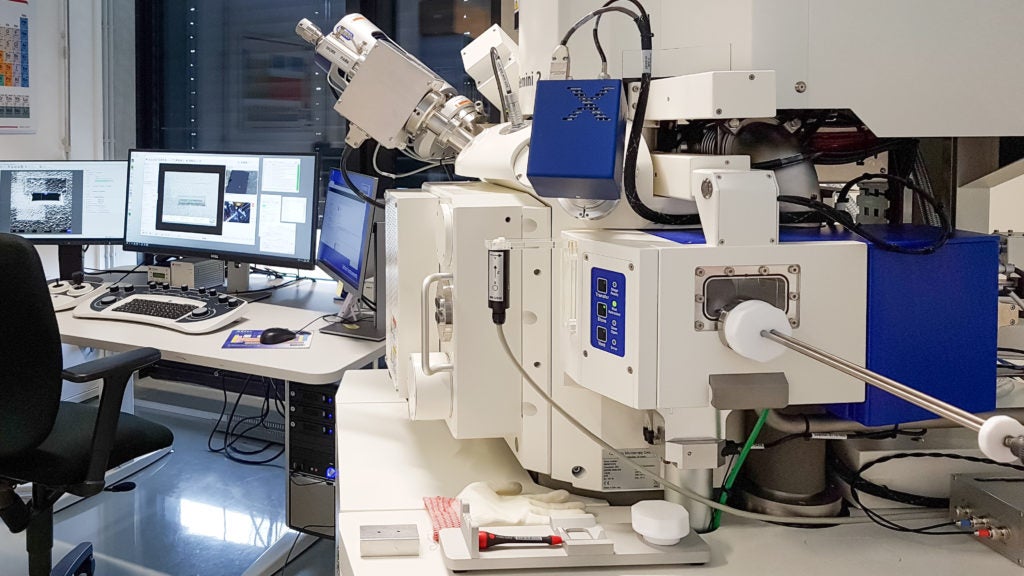
Researchers at the Centre for Solar Energy and Hydrogen Research Baden-Württemberg (ZSW) are using a new scanning electron microscope to investigate solar cells.
The Stuttgart-based centre – considered a leading institution in the research of photovoltaics – has been using the microscope since January 2020 to better understand solar cells’ structure and interfaces on a nanoscale. Researchers are also focusing on defects to improve the quality of photovoltaic systems, reducing CO2 emissions.
Go deeper with GlobalData


Discover B2B Marketing That Performs
Combine business intelligence and editorial excellence to reach engaged professionals across 36 leading media platforms.
ZWS analytics and simulation group leader Dr Theresa Friedlmeier said: “The device opens up new possibilities for us in the investigation of thin-film solar cells. It helps us deepen our understanding of solar cells and develop improved processes with higher efficiencies and lower costs.”
Electron microscopes are used to develop solar cells based on copper, indium gallium and selenium (CIGS), giving three-dimensional images of the cells’ growth, morphology and chemical composition. Three-dimensional images help scientists examine the interface between the CIGS and the layer of cadmium sulphide, spotting cavities and foreign particles in the materials.
“We can now analyse the shape and size of particles and inclusions, and investigate micro-areas using energy-dispersive X-ray spectroscopy,” added Friedlmeier.
The microscope’s focused ion beam will also help researchers prepare materials on a nanoscale, preparing samples for future investigations. “For example, we can use it to prepare good cross-sections of CIGS solar cells on flexible substrates without damaging or separating the individual layers, which had been very difficult in the past.”
The scanning electron microscope was acquired via a €650,000 grant given by the state of Baden-Württemberg, south-western Germany.



