
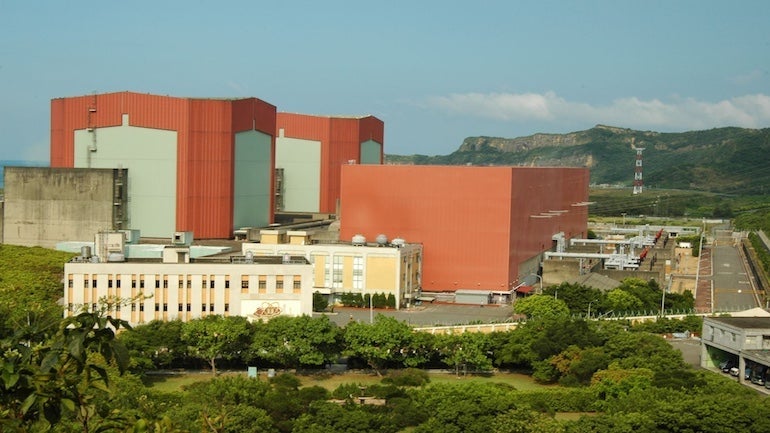
Taiwan’s Ministry of Economic Affairs (MOEA) has approved the current status assessment report of Taiwan Power (Taipower), which found it is feasible to restart the Kuosheng nuclear power plant (NPP) in New Taipei and the Maanshan NPP in Pingtung County (known, respectively, as the second and third NPPs). However, the report concluded that restarting the Chinshan (First) NPP was not feasible.
Taipower is expected to submit a plan for restarting the two plants to the Nuclear Safety Commission by March 2026, the MOEA said. It will also launch safety inspections including assessments of how badly the plants’ equipment has aged and its seismic resilience.

Discover B2B Marketing That Performs
Combine business intelligence and editorial excellence to reach engaged professionals across 36 leading media platforms.
The three NPPs, which generated around 15% of Taiwan’s electricity, were closed after Taiwan’s Democratic Progressive Party was elected to government in 2016 with a policy of creating a “nuclear-free” Taiwan by 2025. The six reactors (two at each NPP) were to be decommissioned as their 40-year operating licences expired.
The Maanshan plant comprised two 936MW-electrical (MWe) pressurised water reactors. Maanshan 2 was the last unit to be closed on 17 May. Maanshan 1 was closed in July 2024. Kuosheng’s two 985MWe boiling water reactors (BWRs) were shut down in July 2021 and March 2023. Chinshan’s two 604MWe Mark-1 BWRs closed in 2018 and 2019.
In addition, work was stopped on two 1.35TWe advanced boiling water reactors under construction at the Lungmen (Fourth) NPP in New Taipei City. Lungmen 1 was completed but mothballed in 2015, and construction of Lungmen 2 was suspended in 2014.
However, in May this year, Taiwan’s Legislative Yuan revised the Nuclear Reactor Facilities Regulation Act, effectively opening the door for a restart of NPPs by allowing operators to renew or extend licences for up to 20 years; however, it was too late for the Maanshan plant.

US Tariffs are shifting - will you react or anticipate?
Don’t let policy changes catch you off guard. Stay proactive with real-time data and expert analysis.
By GlobalDataIn a referendum in August on continued operation of Maanshan, 4,341,432 people (73.5%) voted yes. However, the referendum still failed to pass, as it did not meet the required threshold of 5,000,523 affirmative votes, or 25% of eligible voters. Voter turnout was only 29.53%. Nevertheless, President Lai Ching-te told reporters that, while the referendum had failed, he understood “society’s expectations for diverse energy options”.
Nuclear power advocates had long argued that the NPPs should be restarted and that Lungmen should be completed to provide a baseload source of low-emission electricity.
Taipower’s current status assessment of Chinshan, Kuosheng and Maanshan included an inventory and analysis of seven major aspects: dry fuel storage, current status of safety inspections and preparations, geological seismic resistance, manpower allocation, power supply efficiency, service life extension of similar units and unit equipment.
With respect to Chinshan, the MOEA said: “The equipment is seriously ageing. Most of the important power generation equipment has been dismantled and most of the electrical components need to be replaced and upgraded. Moreover, the units are the same as those of the Fukushima nuclear disaster in Japan [Mark-1 BWRs]. The same type of units in Japan have also been decommissioned, so the First Nuclear Power Plant is no longer feasible to operate.”
As to Kuosheng, the MOEA noted: “The safety and support system… is still regularly overhauled and was maintained during operation. However, the power generation system has been down for more than two years and needs to be overhauled and a recovery control plan needs to be implemented to restore the control plan. Its functionality needs to be reconfirmed. The initial judgment is that there are still conditions for re-operation.”
Equipment at Maanshan has not yet been dismantled. “It has been regularly overhauled and maintained according to operating standards,” the MOEA said. “The reactor has been emptied [of fuel] and the fuel pool still has space. The initial judgment also shows conditions for re-operation. Some equipment has original patents and assistance from the original supplier will be needed.
The MOEA stated that “independent safety inspections and reoperation plans will be initiated simultaneously”. These inspections will include ageing and seismic resistance assessments. The independent safety inspection for Maanshan, which requires peer review and assistance from the original plant supplier, is expected to take around 1.5–2 years. The process will be longer than for the Kuosheng plant because the used fuel in the reactors of the plant still needs to be removed. Used nuclear fuel can only be removed after the on-site dry storage facilities are operational, and this is facing delays. The reactor core must be emptied before reactor-related safety inspections can be conducted.
The MOEA concluded that the restart procedure for the two plants must adhere to “two musts”, and regarding nuclear energy issues, “three principles”. Taipower will be required to conduct related work with the utmost rigour to ensure nuclear safety meets international standards, it said. “Subsequent reviews by international professional technical institutions and peers will be required, and the process will proceed according to the Nuclear Safety Council’s review results. Further social consensus is also necessary.”


