

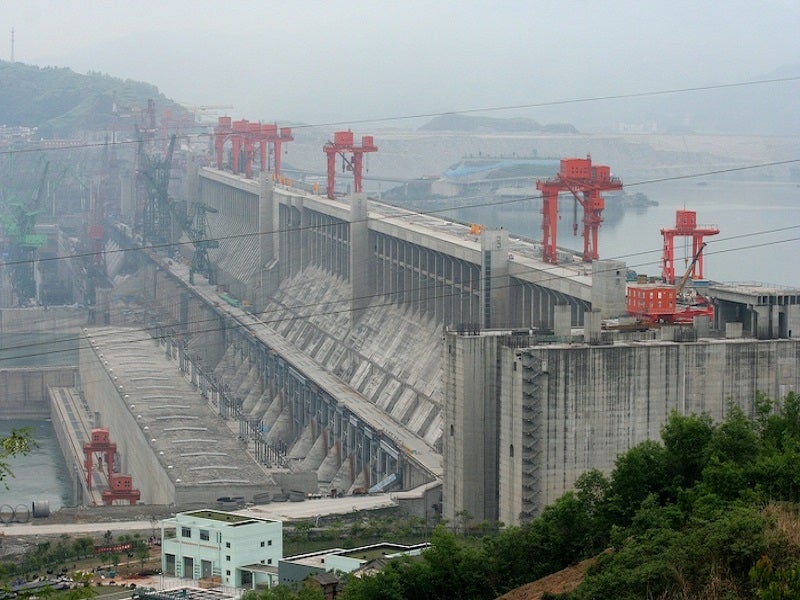
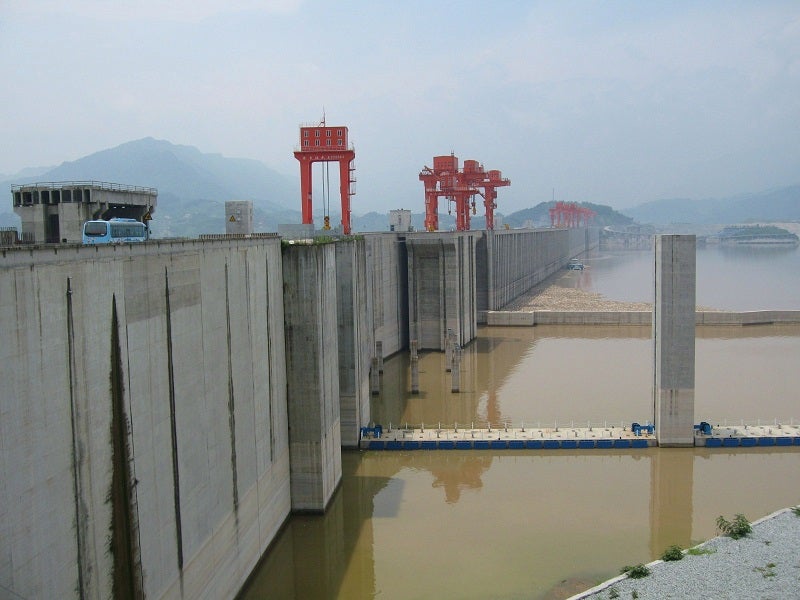
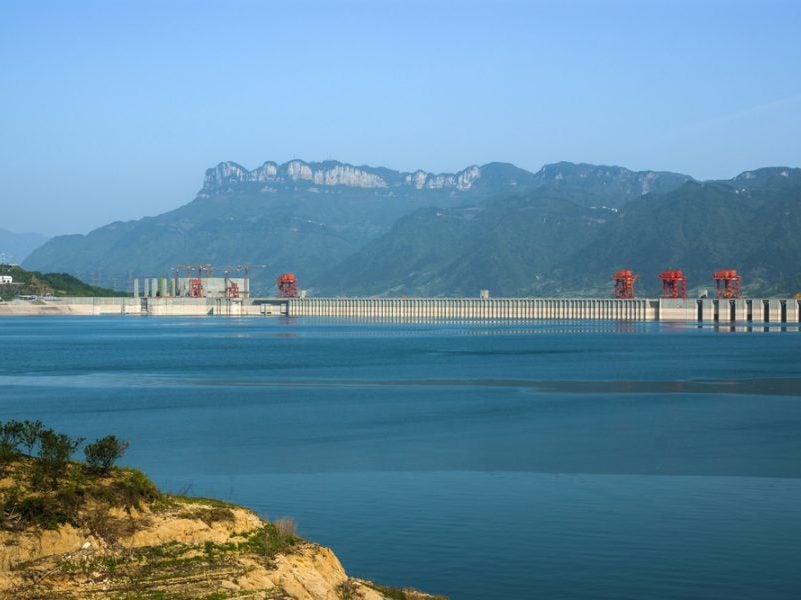
The Three Gorges Dam Project (TGP) is one of the world’s biggest hydropower complex projects, located in the Xilingxia Gorge, one of the three gorges of the Yangtze River, in Hubei province, China.
The gorge controls approximately one million square kilometres of drainage area and averages a runoff of 451 billion cubic metres annually. China Three Gorges Corporation (CTGPC) acts as the legal entity for TGP and is responsible for the construction, operation and financing of the project.
Recommended Buyers Guides

Construction on the Three Gorges Dam was completed in 2008. The dam stands 185m tall and 2,309m wide, making it one of the world’s largest hydro plants, well ahead of Brazil’s 12,600MW Itaipu installation.
A total of 32 main power generators operate off the dam, which includes 12 sets on the right bank and 14 sets on the left installed in 2006 and 2008 respectively. The generators became operational in October 2008 and generated a total of 18,300MW.
Another six generators were added to the underground power plant of the project. The first three became operational in June 2011. The third generator unit (Unit 30) completed a 72-hour test run in July 2011.
The first underground unit (Unit 32) began operations in May 2011 and the second (Unit 31) commenced commercial operations in June 2011. In 2012, all 32 hydro units were commissioned to generate a total of 22,500MW output.
Three Gorges dam project
The Three Gorges Dam project involves harnessing the Yangtze River, Asia’s longest stretch of water, to generate prodigious amounts of electricity.
Its output is estimated at 85TW/h a year, which is close to one-tenth of current Chinese requirements.
Disastrous floods have claimed hundreds of thousands of lives this century alone. The dam directs the floods downstream. Improved navigability on the river allows larger ships to sail from Shanghai to as far as Chongqing upstream from the dam and 2,000km from the sea to aid China’s burgeoning domestic and export trade.
The dam is located 44km from the city of Yichang in Hubei province. This point is at the end of a series of steep canyons that form a 630km reservoir, with an average width of 1.3km. Its capacity is 39.3 billion cubic metres.
The plant is in the centre of a broad plan for central China’s electricity industry. Related transmission and distribution installations are linked to the three regional grids taking power from the Three Gorges Dam, forming a single system from the coast to the border of Tibet.
The grids and their planned shares of offtake are Central China Power Network (55%), East China Power Network (39%) and Sichuan Provincial Grid (6%).
The project consists of a concrete gravity dam with a spillway in the middle. The powerhouse and non-overflow section are stationed at both ends of the dam. The length of the dam is 2,309.5m and the storage level is 175m.
The project has 34 generators, which includes 32 main generators. The other two are power generators with a capacity of 50MW each.
The plant took 17 years to construct and was built in stages by state-backed sponsor China Yangtze Three Gorges Dam Project Development Corporation. Initial works began in 1993. Up to the end of 1996, approximately $2.3bn was invested. The main equipment orders for the 9,800MW first phase were placed in 1997. Fourteen of 32 Francis units of 700MW each were brought online on the left bank of the river (between 2003 and 2006).
In the second phase, 12,700MW units were added on the opposite bank, increasing the total to 18,200MW.
During the second phase, the dam was built to a height of 87m. A 135m-high permanent ship lock with 14 turbines was built on the southern bank. In the final phase, the dam was raised to a maximum height of 185m and an additional 12 turbines were installed on the northern bank of the Yangtze River. A single way one step ship lift system was built at the project complex. The maximum lifting height is 113m and the maximum lifting weight is 11,800t.
The spiral casing began on 26 May 2009. The spiral casing installation was finalised for the generating Unit 27 in May 2010. This completed the spiral casing of all six underground generating units.
Three Gorges power plant
The first 14 generators became fully operational in October 2006, generating 9,800MW at a water level of 156m.
The first (No.22) of the 12 generators became operational on 11 June 2007 and the final generator (No.15) was brought into operation on 30 October 2008.
All 24 generators and two power generators were switched on in June 2009. They produced 16,100MW of power, less than the maximum capacity of 18,300MW. The plant reached its full capacity for a short duration in August 2009 due to elevated upstream water levels and river flow during floods.
Ecological concerns
The long-term ecological effects of the Three Gorges Dam were described as ‘possibly catastrophic’.
The dam will disrupt heavy silt flows in the river and could cause rapid silt build-up in the reservoir, creating an imbalance upstream and depriving agricultural land and fish downstream of essential nutrients.
These problems would also hit the plant’s turbines and millions of farmers and fishermen.
Environmentalist and political opposition to the Three Gorges Dam was intense. The most emotive issue was the forced relocation of 1.27 million people in September 2009.
China referred to the detailed plans as improving the lives of those affected, but residents complained about the resettlement funds and job retraining promises being denied. Farmland that will be flooded is more fertile than the higher ground, and approximately 1,600 factories will be submerged.
Opponents of the Three Gorges Dam had more success outside China. The World Bank, stung by vicious criticism of other hydro projects it sponsored, decided not to fund the project.
The US Export-Import Bank also bowed to the pressure. It hoped to gain further environmental information from the Chinese, which would allow for a positive decision. It was not against the project. Moreover, its stance did not prevent US groups from bidding for contracts, nor US commercial banks from financing their operations.
Ecology and environmental monitoring information system for the project was opened in 2007. Fish Nurturing Centre Base was also built for the conservation of Asian carp and other species through the eco-scheduling process.
The TGP completed 12 eco-scheduling experiments between 2011 and 2018.
Support for the China Three Gorges Dam
European governments snubbed Three Gorges opponents. The export credit agencies of Germany, Switzerland, Sweden, France and the UK all promised support for potential suppliers from their countries.
Japan, after initial hesitation, followed their lead. Canada also offered financing to its companies. Long-term commercial loans by banks in these countries supported the credits.
Arguments, marshalled by the Japanese to support their final decision, provided some answers to the project’s critics. After intensive reviews by the Japanese Ministry of International Trade and Industry, Japan claimed the project offered the following main benefits:
Flood control: Japan believed the project would achieve its objectives in the area, despite claims that it could actually increase the risk of floods, either through changes in silt flow or a catastrophic dam collapse. This issue, in particular, generated a lot of sympathy for the project in Japan.
Emissions reduction: The plant’s output would be equivalent to several large coal-fired plants burning up to 50 million tonnes a year. If it is not built, soaring Chinese emissions would rise even faster, causing more acid rain in Japan.
Relocation: Japan believes current plans are adequate, although the situation would need to be kept under review.
China initially insisted that potential problems were identified and dealt with. However, there were calls on Western governments and companies to refrain from further support of the project until resettlement and human rights problems were resolved. There were claims that the dam did not address the real source of flooding (deforestation in the Yangtze watershed and the loss of lakes that alleviated floods because of siltation, reclamation and uncontrolled development).
Corruption scandals also plagued the project. Contractors allegedly won bids through bribery and then siphoned off construction funds by skimping on equipment and materials. After a number of accidents, much of the project’s infrastructure ripped out in 1999.
Project finance and contracts
The official total cost of the Three Gorges Dam project was estimated as CNY203bn ($29bn), met primarily by special taxes on electricity consumption and revenue from the first phase units operation. But the cost fell to CNY180bn due to lower inflation rate during construction.
The Three Gorges Dam main equipment order was divided between six foreign groups, drawn into two project alliances. Out of 14,700MW units, eight were assigned to Alstom, ABB and Kvaerner, and six to Voith, Siemens and GE.
Alstom did not join the partnership between ABB and Kvaerner or any other leading global name for the bid, but the Chinese side clearly preferred to diversify its risks and gain broad access to Western technology rather than rely extensively on one supplier. This probably helped the Voith, Siemens and GE Hydro alliance, which was formed well ahead of bidding and represents an unusually strong concentration of expertise (GE does not normally work with arch-rival Siemens).
Within the two groupings, work was further divided as follows.
For the eight units, Alstom was the prime turbine contractor, with work worth $212m. Several of its units were involved, led by Mecanica Pesada of Brazil and the Tianjin Chinese hydro turbine joint venture. Kvaerner of Norway supplied design, technology, five runners and components. It put its share of the business at $40m. ABB was chosen to supply eight generators under a contract said to be worth $250m. This took the total value of the eight-unit order to $500m.
The six-unit order was split between Voith, the lead turbine contractor, Siemens, which was required to supply generators, and GE, which carried out turbine and generator work. The entire order was worth an estimated $350m.
Since the first turbine and generator contracts were signed in 1997, Alstom acquired ABB’s power division, and GE Hydro acquired Kvaerner. In March 2004, Alstom was awarded a €163m contract to supply the four 700MW turbines and associated generators to the project’s Right Bank powerhouse.
Technology transfer
Two Chinese equipment suppliers played a major role in the later stages of the first phase. Harbin Power Equipment and Dongfang Electrical Machinery worked with the two foreign groupings, benefitting from extensive technology transfer requirements.
Harbin cooperated with the Alstom, ABB and Kvaerner grouping, and Dongfang with the Voith General Electric and Siemens consortium along with Chinese company Oriental Motor. The last two units of the first phase were almost entirely constructed in China.
Power transmission and distribution
The TGP power distribution and transmission infrastructure was completed in December 2007 at a cost of approximately CMY34.3bn.
The power generated from the dam was transferred to two cities, including Shanghai and nine provinces from three directions. A 500kV DC transmission line on East China Grid, which had a capacity of 7,200MW, a 500kV DC transmission line (HVDC Three Gorges-Guangdong) with a 3,000MW capacity to the South China Grid and a 500kV AC transmission line with 12,000MW capacity to the Central China Grid supported the distribution.
The East China Grid was connected to three 500kV DC transmission lines, which include HVDC Three Gorges-Changzhou with a capacity of 3,000MW, HVDC Three Gorges-Shanghai with a capacity of 3,000MW and HVDC Gezhouba-Shanghai with a capacity of 1,200MW
Construction of Three Gorges Dam
Construction tasks were assigned to Chinese groups. Shortly before the equipment announcements, contracts, worth $800m, went to Gezhouba Share Holding, Yichang Qingyun Hydropower Joint Management and Yichang Three Gorges Project Construction 378 Joint Management. The work included building dikes and the powerhouse.
The plant’s construction involved excavation of 102.83 million cubic metres of rock and earth and refill of 31.98 million cubic metres, 27.94 million cubic metres of concrete placement and the installation of a 256,500t metal frame.
