

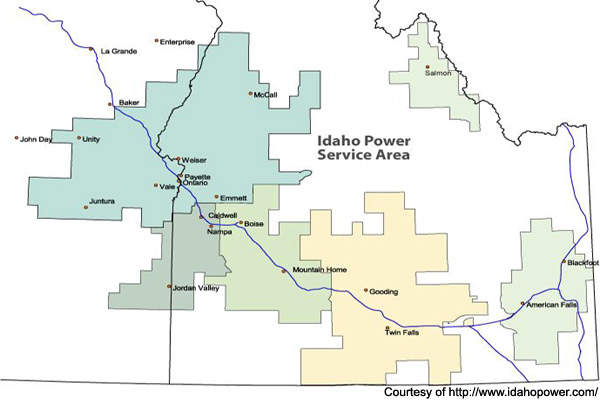
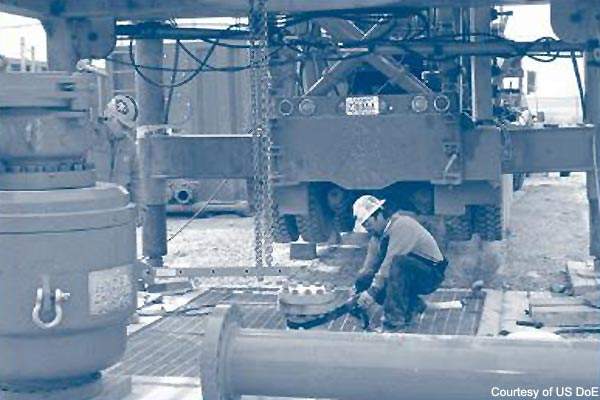
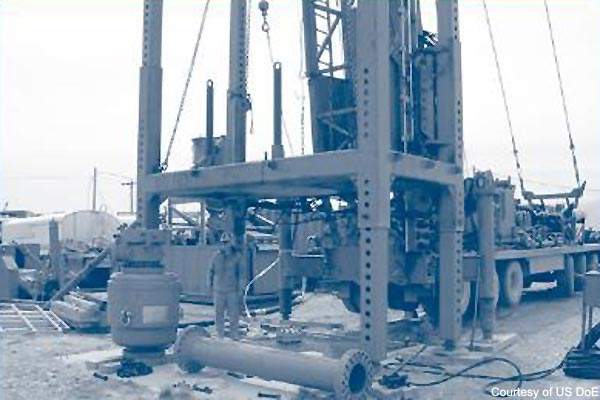
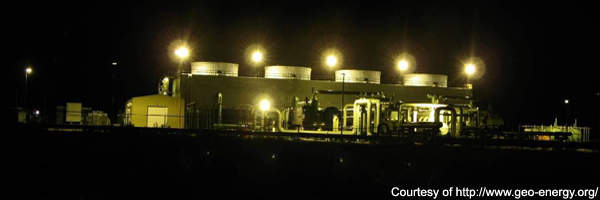
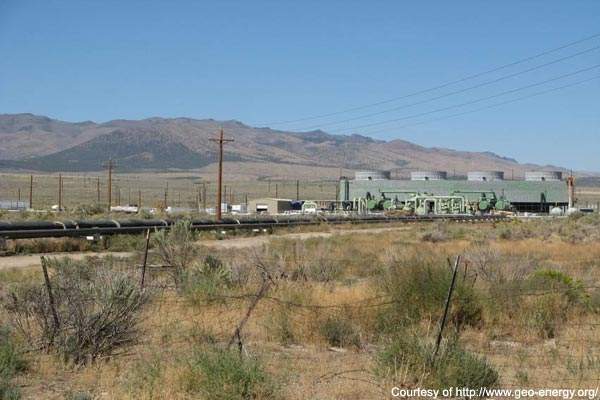
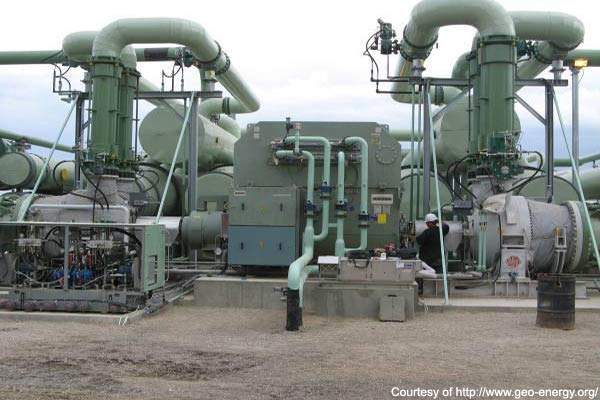
The Raft River geothermal project is now complete, with Unit 1 producing up to 10MW. Raft River is in southern Idaho, US, about 200 miles south-east of Boise, at a former US Department of Energy (DOE) geothermal site. US Geothermal plans to produce up to 36MW from the site.
US Geothermal acquired the project in 2002 and started construction in June 2006. The station started generating power in January 2008, selling it to Idaho Power Company under a 10MW Public Utility Regulatory Policies Act (PURPA) contract. US Geothermal has reserved 36MW of transmission on the adjacent 138kV transmission line.
Recommended Buyers Guides

In 2008 US Geothermal signed a 25-year power purchase agreement with Eugene Water and Electric Board for 16MW power in the planned Unit 2. Under the agreement US Geothermal will supply power to Bonneville Power Administration in Idaho.
In October 2008 the US DOE anounced a $9m grant to US Geothermal to implement enhanced geothermal systems (EGS) stimulation techniques at the Raft River site. DOE has awarded $7.39m of the total grants announced, in September 2009. Implementation of EGS will be performed to thermally stimulate the existing injection well and thus improve permeability of the geologic horizon that contains the reservoir of the Raft River. Work on the EGS began in February 2010.
Previous site
The Raft River project is located at a former US Department of Energy geothermal demonstration project site. The project was operated between 1974 and 1982.
Over $40m was invested in geothermal studies and production infrastructure.
Consulting firm GeothermEx completed a technical geothermal review.
In April 2006 US Geothermal announced a private placement of 25,000,000 shares of common stock at C$1 each. The proceeds went to develop phase one at Raft River, drilling a number of production and injection wells before developing phase two, the latter for possible acquisition of extra geothermal properties and general corporate working capital.
Ormat Nevada Inc, a subsidiary of Ormat Technologies Inc, is the contracting firm. It supplied major pumps, electrical components and other equipment. Raft River Rural Electric Cooperative, the local utility, constructed the power line.
Raft River history and infrastructure
Geoscientific data confirmed a large, moderate-temperature geothermal resource at Raft River, with temperatures up to 150°C at depths between 1,500m and 2,000m. Fluids from the wells are clean with low salt content and total dissolved solid contents between 1,200 and 6,800 parts per million.
Raft River uses a binary cycle system, with the hot geothermal water passing through a heat exchanger to heat the binary liquid. This binary liquid (isobutane in the original design and isopentane in US Geothermal’s plant) vapourises to spin the turbine and generator.
It is condensed and fed back to the heat exchanger in a closed-loop cycle. The lower-temperature geothermal water is injected back into the reservoir.
Raft River saw the world’s first commercial-size binary cycle geothermal power plant, which was built between 1980 and 1982. It was a 7MW dual-pressure system and produced electricity for several months on a test basis. Binary systems are now the leading types for electrical production from moderate temperature geothermal resources.
Conventional Rankine cycle
According to the US Department of Energy, US Geothermal initially proposed using a Kalina (modified Rankine) cycle system. Investors, however, already wary of high upfront risk, were unwilling to fund the project using a technology not commercially proven in the US. The plant therefore uses a conventional Rankine cycle system.
US Geothermal subsequently made a 52MW power sales proposal to Idaho Power, amending the current power purchase agreement to include the full 13MW output of Raft River’s first phase, another 13MW from the planned third phase and 26MW from Neal Hot Springs, Oregon.
Geothermal electric power plants work in a similar way to base load power generators. Their operating availability is 96% or more, which is higher than hydro dams and coal- and natural gas-fired generators.
These modular plants are cost-effective and easily installed. They can be developed in 18 months from concept stage to start-up. As the plants are quickly installed, geothermal fields can be expanded gradually.
