
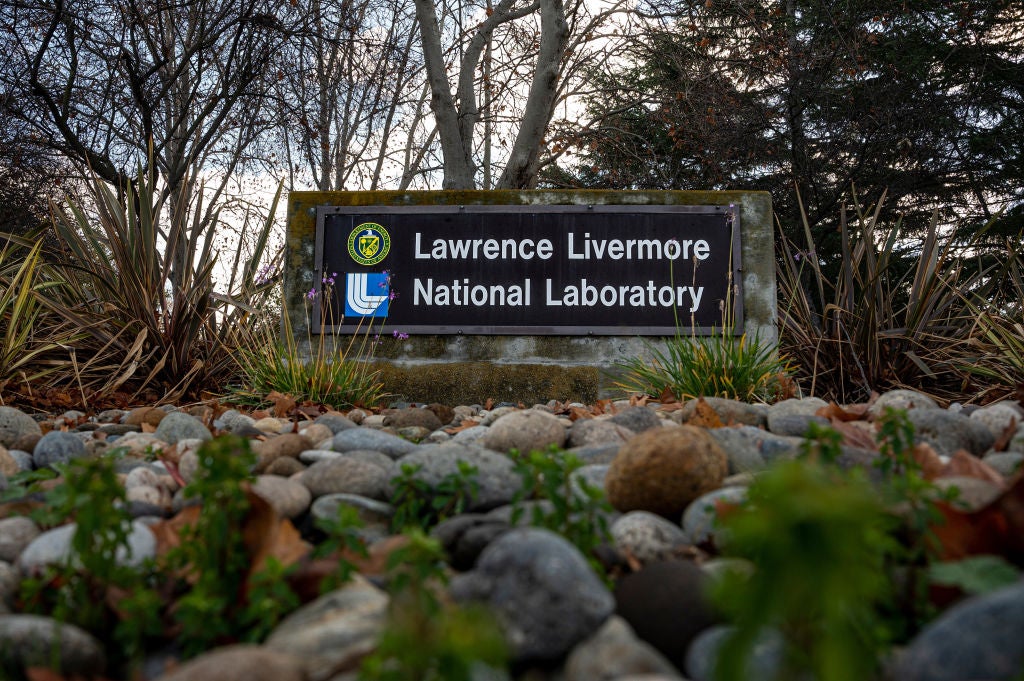
Scientists in the US working at the Lawrence Livermore National Laboratory have achieved net energy gain in a nuclear fusion reaction for a second time, this time with greater yield.
The first such breakthrough occurred in early December last year. According to reports published on Sunday, the laboratory achieved a fusion ignition breakthrough at its National Ignition Facility (NIF) on 30 July that produced a higher yield than December’s breakthrough.
Go deeper with GlobalData


Discover B2B Marketing That Performs
Combine business intelligence and editorial excellence to reach engaged professionals across 36 leading media platforms.
The net energy gain is achieved by using lasers focused on a target to fuse together two light atoms, transforming them into one denser one, releasing high amounts of energy. The experiment in December achieved fusion ignition by generating 3.15 megajoules (MJ) of energy output from 2.05MJ of input.
The exact figures for July’s breakthrough have not yet been published. A spokesperson for the laboratory told Reuters that final results of the latest experiment are still being analysed.
The US Energy Department has called the experiments “a major scientific breakthrough decades in the making that will pave the way for advancements in national defence and the future of clean power”.
Current nuclear reactors use a different process known as nuclear fission. It works in an almost opposite way to fusion by splitting atoms, rather than fusing them together, creating a chain reaction that releases huge amounts of energy.
Uranium or plutonium are the most common elements used in nuclear fission. However, after a reaction has taken place, they leave behind long-lasting radioactive waste that can be harmful and very difficult to properly dispose of.
Nuclear fusion seeks to replicate the processes observed within stars. Once fully harnessed, it has the potential to generate limitless energy with little or no long-term radioactive waste and no carbon emissions. However, stable and reliable fusion remains a long way off, according to scientists.
Despite hopes that fusion could soon play a part in climate change mitigation, the world is “still a way off commercial fusion and it cannot help us with the climate crisis now”, Aneeqa Khan, research fellow in nuclear fusion at Manchester University, told the Guardian just after the initial December breakthrough.
Tony Roulstone, a nuclear energy researcher at Cambridge University, agreed, stating that the December result from NIF was “a success for science, but it is still a long way from providing useful, abundant clean energy”.


