

A year into President Donald Trump’s second term, the US power sector finds itself torn by competing forces. Electricity demand is surging, while trade barriers impede supply growth. The government is backing fossil fuels but rubbing up against the entrenched economics of clean energy, which the administration has sought to curb.
The energy agenda shifted soon after Trump returned to the White House in January 2025. He relegated climate priorities in favour of speed and reliability, deeming this the winning formula for economic prosperity and national security.

Discover B2B Marketing That Performs
Combine business intelligence and editorial excellence to reach engaged professionals across 36 leading media platforms.
Data centres have fuelled this mission with a practical urgency. Trump has been unequivocal about expanding domestic digital infrastructure, and this ambition translated across energy policy.
“In his executive orders (EOs) on data centre expansion, he treats energy as a core asset,” says James Roth, head of policy at Bloom Energy and former director in the Executive Office of the President under the Clinton and Bush administrations. “When the White House issues that kind of edict, from my experience, it sends a clear signal to federal and state regulators to enact policies or regulations consistent with that.”
Simultaneously, tariffs have been the most disruptive policy tool of Trump 2.0, with GlobalData reporting tariff-related job postings in the power sector surged 657% year-on-year in 2025.
By the end of his first year, average effective US tariff rates had climbed to around 15%, levels not seen in decades. Key equipment and components for power generation, transmission and distribution have been caught in the crossfire, driving up project costs and heightening market uncertainty.
Power demand has soared relentlessly amid this chaos, forcing utilities, developers and investors to adapt, regardless of Washington’s priorities.
Trump tariffs and power, a summary
Trump returned to office with a guns-blazing approach to trade; early on, he targeted Chinese goods with tariff rates as high as 60%, including renewable energy components, before extending duties to other key trading partners like South East Asia and Europe. In June 2025, steel and aluminium tariffs doubled to 50%, while a new 50% tariff on copper took effect in August. These materials are critical to every part of the power system, including but not limited to turbine towers, solar frames, transformers and transmission lines.
“While the goal [from the tariffs] is to stimulate domestic manufacturing, the immediate effect has been a disruption of established supply chains and higher prices for essential components and materials for US energy,” explains Pavan Vyakaranam, senior power analyst at GlobalData.
GlobalData estimates that Trump’s tariffs on steel, aluminium and copper increased overall project costs for US power generation assets by 6%–11%. While solar and battery storage have been hit hardest, other assets – including those favoured by Trump, like gas plants – were also ensnared in collateral damage.
The new economics of power: how has Trump 2.0 affected each technology?
Nuclear power
Nuclear power has been one of the clearest beneficiaries of Trump’s second term. The administration has framed it as a cornerstone of energy dominance and security, as well as data centre expansion.
In May 2025, Trump set a target to quadruple US nuclear capacity by 2050. He followed up with multiple EOs aimed at reinvigorating the nuclear industrial base, reforming reactor testing and reshaping the Nuclear Regulatory Commission to accelerate approvals.
“At first glance, Trump’s approach might seem just domestic-focused and less international [than other administrations], but there has also been a lot of bilateral cooperation,” World Nuclear Association representative Henry Preston clarifies. In 2025, the US established agreements with the likes of South Korea, Japan and the UK on advanced fuels, reactor designs and heavy-component manufacturing. Most notably, in October, the government partnered with the Canadian owners of Westinghouse Electric to develop new nuclear reactors, with a projected investment of $80bn.
Preston notes that the Trump administration’s nuclear strategy has not deviated much from previous policy. Under Biden, the Inflation Reduction Act (IRA) delivered significant support for nuclear, and the US led international coordination on the COP pledge to triple global nuclear capacity.
“Trump’s approach has been a different mechanism – primarily executive orders,” he says, “but overall, I think it is more of a continuation, just with a different emphasis and delivery.”
What has indeed changed since Trump’s first term is demand, primarily coming from digital infrastructure expansion. AI data centres have spotlighted nuclear more than ever, given their compatibilities in load profiles. “We are now seeing groundwork for small modular reactors across the US and major investment in advanced fuels, mainly to power data centres,” Preston adds.
“Rising demand, energy security and reliability – those three factors are really driving support for nuclear,” he says, “and they are unlikely to fade regardless of who occupies the White House.”
Thermal power: gas and coal
President Trump has, for the most part, delivered on his ‘drill, baby, drill’ campaign promise in his first year back in office.
“Trump’s speed-focused energy approach centres around expediting the permitting and approval timelines for energy infrastructure – especially oil, natural gas and coal projects – by streamlining environmental reviews and reducing regulatory friction,” Vyakaranam explains.
In 2025, Trump has solidified federal backing for new combined-cycle plants, issued EOs to prioritise hydrocarbon projects, expedited permitting following revisions to the National Environmental Policy Act, and instructed the Federal Energy Regulatory Commission to accelerate approvals for new pipelines and LNG capacity.
The president’s enthusiasm for data centres has further strengthened gas’ position, with Vyakaranam noting: “With Trump’s pro-fossil fuel policies in place, it is both more economical and, from a clearances perspective, easier to roll out gas-based projects than others like renewables for data centres.”
Coal power has seen similar support. Karen Wayland, CEO of the GridWise Alliance, points to the administration’s push to keep large conventional generating resources online, including rolling back Clean Air Act rules for coal plants and issuing emergency orders to delay retirements.
The favouritism is even clearer with the thermal sector’s tariff exemptions; none of Trump’s tariffs have been applied to crude oil, natural gas or refined fuel imports, with the purpose of safeguarding the feedstock imports on which most of the Gulf Coast’s refineries rely to produce US petroleum products.
However, fossil developers still rely on steel, aluminium and copper imports – all subject to tariffs. Therefore, “although Trump’s policies promote the advancement of fossil fuels, his tariffs on key materials have raised the cost of pipelines, compressors and plant equipment,” says Vyakaranam.
“The resulting higher construction and maintenance costs risk feeding into consumer electricity prices,” he adds.
Renewable power: solar, wind and hydro
Clean energy developers braced for storm as soon as Trump’s victory was announced in 2024.
As anticipated, the first year of Trump’s second term saw federal support weaken. The One Big Beautiful Bill Act (OBBBA) slashed IRA incentives for renewables, including accelerating the end of eligibility for clean electricity production and investment tax credits; the Department of Energy’s clean energy grant programmes were scaled back; offshore wind leasing was paused; and national clean electricity targets were effectively shelved, with deployment now driven primarily by state mandates.
According to GlobalData, clean energy project cancellations reached around $8bn in the first quarter of 2025 alone.
Globally, module oversupply has lowered the costs of solar projects. Yet in the US, tariffs and anti-dumping duties have pushed costs back up over the past year. GlobalData estimates Trump’s tariffs have raised US utility-scale solar project costs by around 20%–54%, across different scenarios, driven by the spike in imported module and inverter prices.
While domestic manufacturing has grown, Vyakaranam notes that the US still lacks upstream scale, thereby extending procurement lead times and limiting the sector’s ability to absorb tariff shocks.
Wind power – especially offshore – has faced the most direct backlash. On his first day back, Trump signed a memorandum pausing all new or renewed leasing and permitting for wind projects. Subsequently, his administration issued stop-orders on several large-scale offshore projects, rescinded $679m in grants for wind energy infrastructure, and launched investigations into the “national security risks” of wind projects and imported wind components.
The president’s long-standing opposition to the sector culminated in December with the suspension of five major offshore projects on the grounds of national security. Although developers quickly retaliated with legal proceedings, the move had already triggered a sharp sell-off of US wind market shares.
Tariffs were an additional layer to the damage. The price hike on imported steel and aluminium – integral to wind turbines – has significantly driven up project costs. Dominion Energy’s 2.6GW Coastal Virginia project, for instance, reported an estimated capital cost rise from $10.9bn to $11.2bn resulting from tariffs.
While onshore wind, relative to offshore, has been shielded by Trump’s policy shifts, the sector has still been exposed to trade measures. Vyakaranam estimates that tariffs could raise US onshore wind capital expenditures by up to 9% and increase the subsidised levelised cost of energy by up to 11%.
“The direct impact of tariffs encompasses elevated input expenses, whereas indirect consequences arise from disturbances to the equilibrium of supply and demand within intricate international supply chains.”
Trump’s policies have resulted in increased uncertainty, project delays and price hikes for the US solar and wind industries, reducing their competitiveness against fossil fuels.
Yet experts argue that these rollbacks have not fundamentally changed the trajectory for US renewable energy.
Despite the policy headwinds, renewables continued to flourish in 2025, buoyed by the underlying economics and long-term policy frameworks like the IRA. Wind and solar remain among the cheapest sources of new power, while utilities face a growing need to add capacity.
The outlook remains strong, Vyakaranam stresses, with GlobalData projecting that solar power will account for 61.7% of investments in the power market between 2025 and 2030.
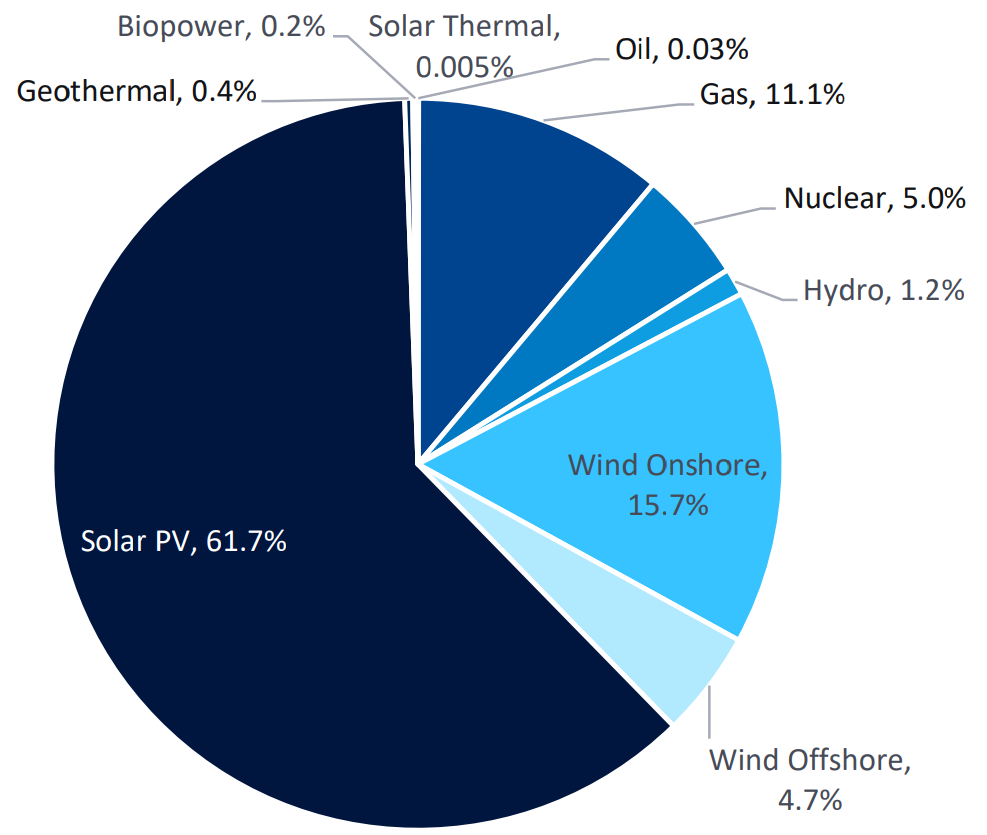
“Some projects in development might have been slowed because of reduced tax incentives or other policy setbacks. But the reality is, because of the growing cost differential between renewables and conventional fossil fuel generating resources, utilities are likely to keep adding renewable energy,” Wayland confirms.
Meanwhile, hydropower stood out as a renewable technology favoured by Trump. The administration has explicitly prioritised hydropower development as part of its ‘America First’ energy agenda, recognising its role in grid reliability and energy independence. The OBBBA also retained tax credits for hydropower projects starting construction by the end of 2033.
Energy storage
While generation policy has dominated headlines, the real constraint of the power sector in 2025 has been delivery. Data centres alone drove a more than 20% increase in US grid power needs, according to GlobalData, while the country’s interconnection queues swelled to more than 2.6TW of planned capacity.
To manage the grid bottleneck, energy storage has emerged as one of the most resilient technologies under Trump. While the IRA’s renewable tax credits were rolled back, those for stand-alone storage remained intact through the mid-2030s.
“Storage was largely spared, mainly due to data centres,” comments Arvin Ganesan, CEO of grid-scale storage developer Fourth Power. As grids are proving incapable of handling the demands of these energy-intensive facilities, storage has served as an appealing solution, allowing for “power delivery when the centre needs it”.
“More fundamentally, battery facilities can be built in roughly two years, far faster than large-scale generation or transmission upgrades,” he adds.
However, the energy storage market, too, was not immune to tariff impacts. Given China’s dominance over lithium-ion battery supply chains, alongside tariffs on other key materials like copper and aluminium, Trump’s trade policies have “significantly increased the cost of energy storage project development, hindering further investment”, Vyakaranam explains. GlobalData projects tariffs to have increased the costs of US grid-scale battery systems by 12%–50%.
Ganesan believes that “despite these short-term impacts, storage will continue to grow in the US”. GlobalData analysis supports this outlook; US battery storage surpassed 40GW in operational capacity in 2025 despite tariff repercussions and is set to be the country’s fastest-growing grid resource in the next decade.
The politics of addressing the power crunch
“Trump has rebranded energy as a strategic asset underpinning industrial competitiveness and geopolitical leverage,” summarises Vyakaranam. But his partiality for certain energy technologies and quest to curb foreign reliance through trade barriers could ultimately clash with other priorities.
The underlying challenge remains the same; the country needs more electricity. Data centres, new manufacturing capacity and the wider electrification of the economy are creating demand faster than the grid can respond. The more aggressively the Trump administration pursues an expansion of US industry and digital infrastructure, the less room there may be for politics to dictate what gets built.
The question for US power in 2026 will be whether Washington can continue to bend policy to Trump’s will without slowing the buildout – across the full energy spectrum – that the country urgently needs.


