


Anyone who follows data centre news would have noticed the announcements getting bigger. What used to be a regional facility serving nearby businesses is now, more often than not, a multi-billion-dollar campus built for training AI models. The project data puts firm numbers on that impression.
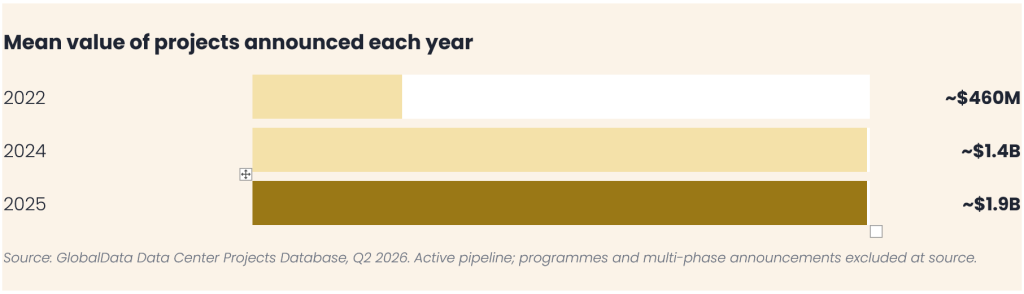
Across GlobalData’s active pipeline, projects announced in 2022 have an average value of around $460M. For projects announced in 2025 the average is roughly $1.9B, about four times as much in three years, and it has risen every year in between. The typical project has grown too, with the median announcement roughly tripling from around $200M to about $640M over the same period, so this is a genuine shift across the market rather than the work of a few extreme outliers.
The cause is no mystery, because the AI training campus has replaced the regional facility as the standard announcement, and a campus consumes land, power and capital on a different scale. The consequences are less obvious.
Growth in scale is not growth in breadth
The first consequence is for anyone reading pipeline growth as market growth. When the average project quadruples in size, the headline value of the pipeline can surge even while the number of new schemes grows far more slowly. Recent growth increasingly reflects bigger projects rather than more of them, so a market sized from headline value alone will overstate how broad demand really is.
The second consequence is for risk. A pipeline made of fewer, larger schemes is one in which individual outcomes matter more. Each giant campus needs a transmission-level grid connection, a longer approval path and more capital resting on a single decision, which means the projects now carrying most of the pipeline’s value are also the slowest and least predictable to deliver.
What this means in practice
Bigger projects mean lumpier demand. Winning or missing a single campus now moves a year’s order book in a way the old flow of mid-sized facilities never did, and competing for that work takes tendering resources of a different order.
It concentrates financing exposure too. What would once have spread across ten mid-sized facilities now often sits on a single campus, in a single market, behind a single grid connection, so diversification has to be built deliberately rather than assumed.
All of which makes the vintage of any quoted pipeline worth checking. A pipeline dominated by announcements from 2024 onwards is a pipeline of giant, early-stage, power-hungry schemes, and it will convert into revenue more slowly and less evenly than the same dollar figure would have implied three years ago. Working out which of these giant schemes will actually arrive takes project-level evidence. GlobalData’s Data Centre Projects Database tracks each of the roughly 2,500 developments in the pipeline individually, recording its value, stage, location, owner and recent activity from announcement through to completion, which is what assessing delivery risk on a $2B campus requires.
GlobalData’s free whitepaper, The Deliverability Gap, applies that evidence to the whole pipeline, showing how much of it is genuinely deliverable by 2030 and what that means for construction spending. It is free to download below.
