

The Inch Cape offshore wind farm being developed in the North Sea off the coast of Scotland, UK, will have a capacity of 1.08GW.
The project is being implemented by Inch Cape Offshore, an equal equity joint venture between Energy for Generations, an Ireland-based energy company, and Red Rock Power, an Edinburgh-based investor, owner and operator of renewable energy projects.
Recommended White Papers

Recommended Buyers Guides

The project was awarded a contract for difference (CfD) in July 2022 and concluded its onshore enabling works in October 2023. The principal civil engineering works commenced in early 2024.
Furthermore, in September 2024, the project was awarded an additional CfD in the UK Government’s latest allocation round for 266MW.
The project, which achieved financial close in January 2025, is being developed with an estimated investment of more than £3.5bn ($4.7bn).
First power from the project is expected in late 2026, with commercial operations expected to begin in 2027.
Inch Cape will make a considerable impact on the UK’s offshore wind objectives and is expected to generate more than five terawatt-hours per year of renewable energy, sufficient to supply more than half of the homes in Scotland.
The project is also expected to offset up to 2.5 million tonnes per annum of carbon emissions once operational.
Inch Cape project location
The Inch Cape offshore wind farm is located approximately 15–22km off the Angus coastline in the North Sea at water depths ranging between 45m and 55m.
The project covers a total development area of approximately 150km².
Inch Cape offshore wind farm make-up
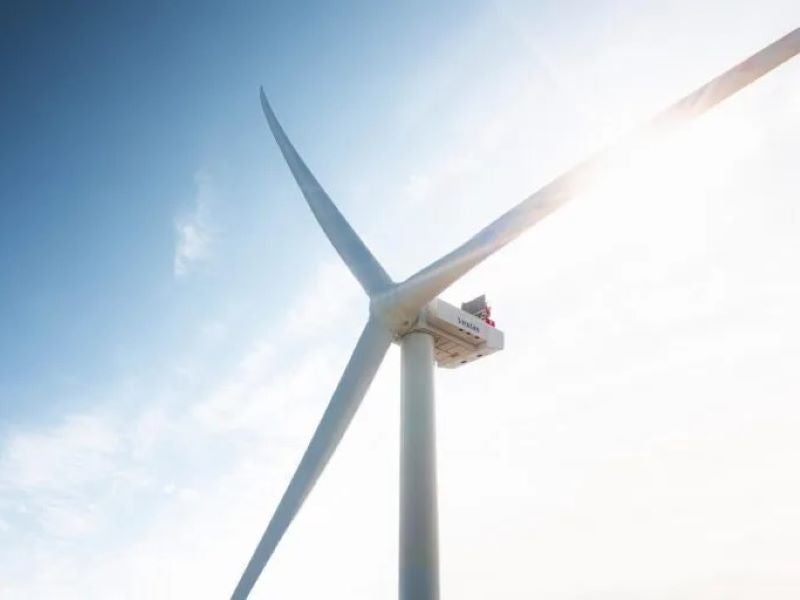
The Inch Cape offshore wind farm will comprise 72 units of V236-15MW wind turbines from Vestas.
The V236-15MW turbines have a rotor diameter of 236m (774.27ft) and a swept area of 43,742m² (470,834.96ft²). The turbine blades measure 115.5m in length, enabling a capacity factor surpassing 60%.
The turbine design incorporates a medium-speed gearbox and an aerodynamic brake with full blade feathering and three-pitch cylinders.
The turbines will be installed on a combination of monopiles and jacket foundations. The two separate foundation designs were developed to suit the varying seabed depths.
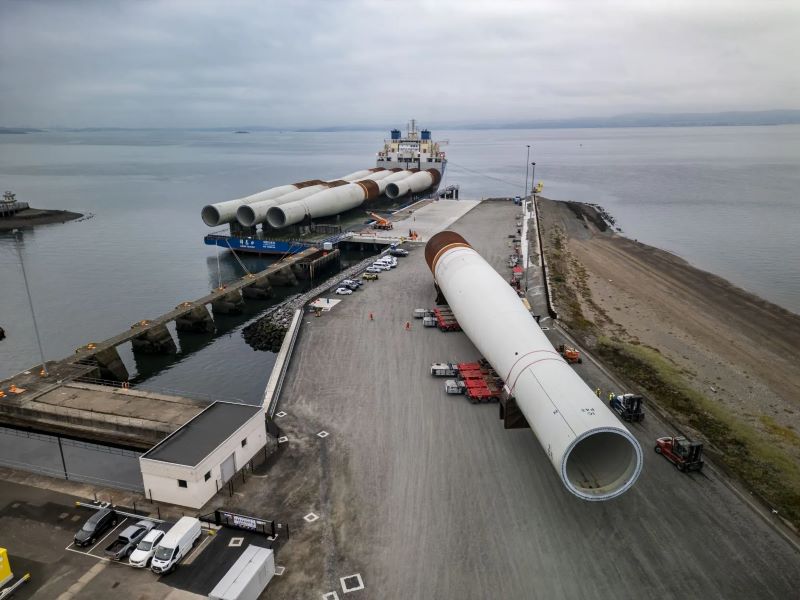
The project will use 54 XXL monopiles and transition pieces. The monopiles will each have a maximum diameter of 11.5m, a length of 110m and weigh up to 2,700t.
Additionally, it will use 18 jacket foundations made from a braced steel lattice structure with three supporting legs and an integrated transition section, to which each turbine tower will be secured.
The jacket foundations will weigh 2,250t and will be up to 83m tall. These units are engineered and manufactured to cope with demanding offshore conditions and to provide a robust base for the project’s turbines.
Power transmission
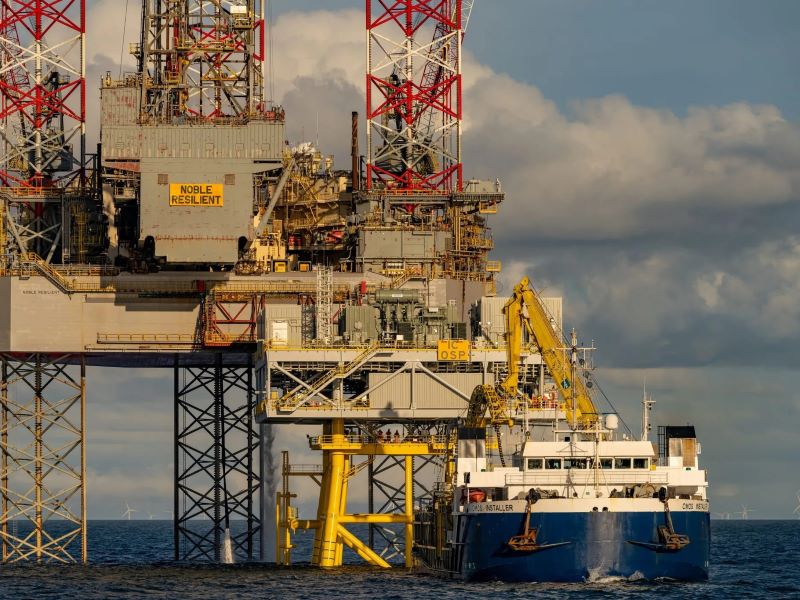
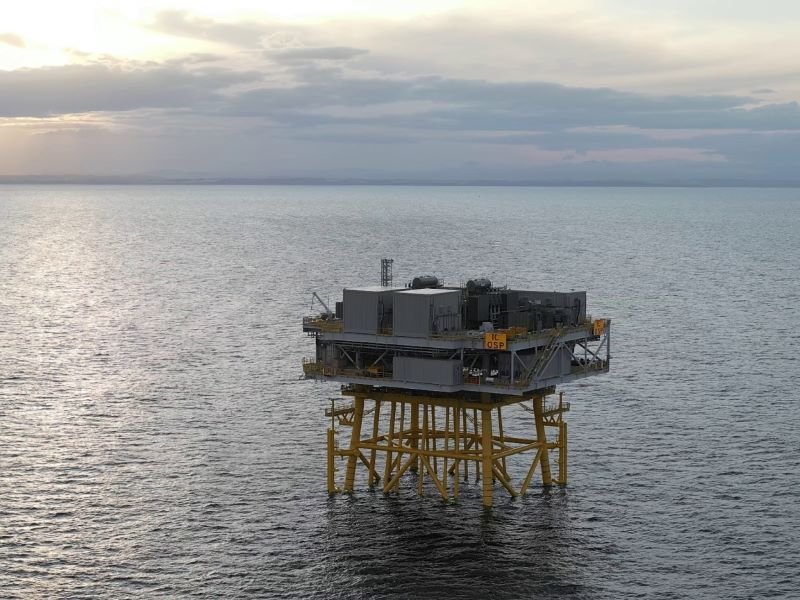
Around 150km of inter-array cabling will collect the generated power and feed it into a single 66kV/220kV offshore substation platform, installed on a 68m jacket foundation within the wind farm.
The 2,700t platform marks Siemens Energy’s first double Offshore Transformer Module. It will be equipped with an array of critical components including two 545 megavolt-ampere main transformers, two 500 kilovolt-ampere auxiliary transformers, a pair of 220kV gas insulated switchgear (GIS) container modules and two 66kV GIS container modules.
Power from the offshore substation will then be delivered to the shore at Cockenzie in East Lothian through two 220kV subsea export cables over 85km.
At landfall, the export cables will connect to a short onshore section that links to a new 220/275kV onshore substation being built on the former Cockenzie Power Station brownfield site.
The onshore installation will include two supergrid transformers alongside shunt reactors, harmonic filters, static var compensators and other associated electrical equipment.
Electricity will then be routed roughly 300m underground to the existing Scottish Power Energy Networks 275/400kV substation, where it will be transferred into the national transmission system for onward distribution. Operations and maintenance will be managed from a purpose-built base at the Port of Montrose in Angus.
Construction milestones
The offshore substation platform and its jacket foundation were successfully installed by August 2025.
The first shipment of XXL monopile foundations arrived in the Port of Leith in October 2025, with installation being carried out using Jan De Nul’s heavy lift vessel the Les Alizés.
The first offshore cable was installed in the same month, comprising a 220kV, three-phase export cable that was installed in three 28km sections by Enshore Subsea using the CMOS Installer cable lay vessel.
The first three jacket foundations for the project arrived at the Port of Leith in March 2026.
Power purchase agreement
Inch Cape Offshore signed a long-term route-to-market power purchase agreement with SSE Energy Markets in September 2024.
Under the terms of the contract, SSE Energy Markets will offtake 50% of the wind farm’s electricity output and associated environmental benefits for a period of at least 15 years.
This agreement provides Inch Cape with a reliable route to market for its clean electricity from early generation.
Contractors involved
In September 2024, the Inch Cape Offshore Wind Farm entered into an agreement with Vestas for the supply, installation and commissioning of 72 turbines, alongside a long-term service and warranty package and a bespoke operational support arrangement.
Monopile foundations have been awarded to CWHI, also known as GWSHI, and Dajin Offshore, while transition pieces are being supplied by CWHI and CFHI, part of COOEC Fluor.
CFHI is also providing the jacket foundations, with Seaway 7 responsible for installing the jacket foundations, associated transition pieces and the pin piles. Heavy lift crane vessel Seaway Alfa Lift is carrying out the installation of the wind turbines.
Jan de Nul was selected to install the monopiles under the RWE lease, while the inter-array cable engineering, procurement, construction and installation scope was awarded to TKF and N-Sea.
Ningbo Orient Cable is supplying the export cables, with Enshore Subsea contracted for installation.
Forth Ports is providing the marshalling ports at Dundee and Leith, and the Port of Montrose is serving as the construction base.
Boskalis signed an exclusive pre-construction agreement for the Inch Cape Offshore Wind Farm project in January 2019. The scope of work includes transportation and installation of the wind turbine foundations, offshore substation and cables.
Cadeler, an offshore wind farm construction company, was contracted in June 2024 to install the 72 wind turbines for the project under a contract valued at up to €130m ($138m). Turbine installation will be carried out using one of Cadeler’s newbuild M-class wind turbine installation vessels.
Siemens Energy and Iemants, a subsidiary of Smulders, were selected to supply and construct the onshore and offshore substations. Smulders (Iemants) subcontracted Eastgate Engineering in July 2024 for the electrical and mechanical installation on the offshore transformer modules.
Lloyd’s Register Engineering provided impartial certification services to ensure compliance, offer assurance and mitigate risks for the successful execution of the project.
Vysus Group, an engineering and technical consultancy, provided a steel jacket design with optimised transition piece concepts for wind turbine generator installations and alternative bracing arrangements.
The main civil works for the onshore transmission infrastructure are being undertaken by civil engineering contractor Careys.
RJ McLeod, a civil engineering company, completed the enabling works in October 2023 for the onshore infrastructure.
Heerema Marine Contractors is carrying out the installation of the offshore transformer platform and jacket foundation using the semi-submersible crane vessel the Sleipnir.
Inch Cape received support during the financial close process from MUFG, which acted as financial adviser to ICOL, and Linklaters, which served as ICOL’s legal adviser. K2 was appointed as the lenders’ technical adviser, while Norton Rose Fulbright acted as legal adviser to the lenders.
