
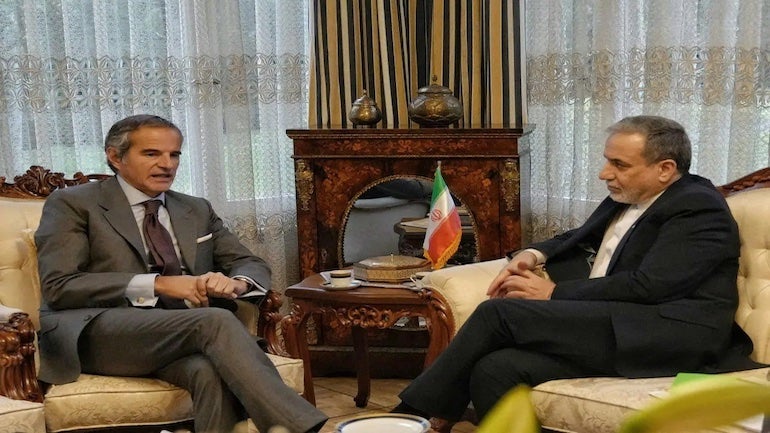
Iranian Foreign Minister Abbas Araghchi has held high-level consultations in Geneva ahead of a second round of indirect negotiations with the US.
He met with Omani Foreign Minister Sayyid Badr Albusaidi to finalise coordination before the official start of the indirect talks, outlining Iran’s position on key nuclear issues and the lifting of economic sanctions. Araghchi emphasised Iran’s determination to pursue “result-oriented diplomacy” to secure the legitimate rights of the Iranian people and maintain regional stability.

Discover B2B Marketing That Performs
Combine business intelligence and editorial excellence to reach engaged professionals across 36 leading media platforms.
He previously met with International Atomic Energy Agency (IAEA) director-general Rafael Grossi. The Iranian Foreign Ministry said they discussed technical issues related to safeguards cooperation and “the implementation of the Iranian Parliament’s law regarding the nuclear programme”. The parliament had adopted a law banning any cooperation with the IAEA in the wake of the June 2025 Israeli and US attacks on its nuclear facilities. Israel had accused the IAEA of passing information on its nuclear facilities to the US and Israel.
Earlier, speaking during a session on the sidelines of the Munich Security Conference, Grossi said that Iran has the right to benefit from peaceful, civilian nuclear capabilities. He said the IAEA continues to conduct inspections in Iran, although these do not include facilities that were targeted in the attacks.
He said the 12-day war had fundamentally altered Iran’s nuclear landscape, arguing that the equation has changed not only in terms of capabilities but also regarding infrastructure that no longer exists or has been severely damaged.
While acknowledging some level of progress in cooperation with Tehran, Grossi emphasised that further verification measures are required. He concluded that reaching a new agreement with Iran on nuclear inspections is possible but described the process as very difficult.
His discussions with Araghchi in Geneva also touched upon technical viewpoints relevant to the indirect negotiations with Washington. Iran and the US had resumed indirect diplomacy in Muscat on 6 February, nearly eight months after a suspension of contacts following US-Israeli military strikes.
Iran’s primary demand remains the effective and verifiable lifting of economic sanctions, with officials stating that any deal without tangible economic benefits would be meaningless. The negotiations are taking place against a backdrop of a US military build-up after US President Donald Trump deployed an additional aircraft carrier, fighter aircraft and guided-missile destroyers to the region.
The strikes in June 2025 had taken place while US-Iran negotiations were under way. Trump has threatened strikes against Iran if a deal to curb its nuclear programme cannot be reached. Iran has warned of a massive military response should the US attack again. “I am in Geneva with real ideas to achieve a fair and equitable deal,” Araghchi wrote on X. “What is not on the table: submission before threats.”
Earlier, Iran’s Deputy Foreign Minister, Majid Takht-Ravanchi, signalled that Tehran could be open to compromise on the nuclear issue but sought an easing of international sanctions led by the US. “The ball is in America’s court. They have to prove they want to have a deal with us,” he told the BBC. “If they are sincere, I am sure we will be on the road to an agreement.”
He said Iran is prepared to consider steps on its stockpile of highly enriched uranium (HEU) as part of a nuclear deal with the US, but the demand for zero enrichment is not on the table. He added that Tehran was ready to discuss curbs on its nuclear programme, including measures related to its roughly 400kg stockpile of HEU, if Washington was willing to lift sanctions. “If they are ready to talk about sanctions, we are ready to discuss this and other issues related to our nuclear programme,” he said
Turkey’s Foreign Minister, Hakan Fidan, told the Financial Times that expanding nuclear talks with Iran to include its ballistic missile programme and regional activities would risk triggering another war. Iranian officials have repeatedly said negotiations should focus solely on the nuclear dossier. Fidan believes agreement would be possible on this basis.
“The Iranians now recognise that they need to reach a deal with the Americans, and the Americans understand that the Iranians have certain limits. It is pointless to try to force them.” He said he believed Tehran “genuinely wants to reach a real agreement” and could accept restrictions on enrichment levels and a strict inspections regime, similar to the 2015 Joint Comprehensive Plan of Action (JCPOA). This agreement capped enrichment at 3.67% and sharply limited Iran’s stockpile.
Iran had been under massive sanctions since 1979, imposed by the US and Europe and later also by the UN because of allegations that it was developing a nuclear weapons programme. UN sanctions were lifted in 2015 when Iran signed the JCPOA with the P5+1 group of countries (the US, UK, France, Russia and China, plus Germany) under which Iran had agreed to limit its nuclear development programme and allow IAEA inspections of its nuclear facilities.
However, most US sanctions remained in place, and were tightened when the US withdrew from the JCPOA in 2018. After a year of fruitless negotiations, Iran, in turn, began to ramp up its nuclear programme again. It is clear that Tehran would now be willing to agree to another JCPOA-type agreement. So, as Takht-Ravanchi told the BBC, the ball is in the US’ court.


