
Global small modular reactor (SMR) activity is accelerating, with capacity expected to increase from a baseline of approximately 300MW in 2025 to around 1.7GW by 2030, 5.6GW by 2032 and more than 39GW by 2040. This is the latest forecast to emerge from GlobalData, the parent company of Power Technology, and chimes with broadly bullish estimates for SMR development over the coming decade.
As the GlobalData analysis observes, the market pipeline is large and growing, and seven SMR design types are already either operating or under construction. Driven by climate targets, concerns over security of energy supply, and rising demand for both heat and power, the rationale behind this projection for a steep growth curve in SMR capacity is sound. There is clear evidence that leading nuclear nations such as China and Russia are accelerating SMR developments, while the US and Europe are ramping up design approvals, licensing and early deployment.
Go deeper with GlobalData


Access deeper industry intelligence
Experience unmatched clarity with a single platform that combines unique data, AI, and human expertise.
While all this suggests a rosy outlook, GlobalData also points to a number of clouds that may yet darken the SMR horizon. It notes, for example, that the leading contenders in the near term are dominated by light-water designs such as the Rolls-Royce SMR or the GE Vernova Hitachi BWRX-300. While these designs benefit from established safety cases and experienced licensing approaches, with rated capacities of 300MW-electrical or more they share a great deal with the larger light-water reactors that dominate the current nuclear fleet.
Conversely, emerging SMR technologies offer a wealth of different design philosophies such as high-temperature gas-cooled reactors, liquid-metal fast reactors, molten salt reactors and microreactors, which positions them for emerging applications such as those requiring process heat; for example, hydrogen production, or remote, off-grid or military needs. However, while the promise of these novel designs includes factors such as higher efficiencies or better passive safety systems, they are much further away from serial deployment.
Given that almost all SMRs are still at the first of a kind (FOAK) stage with limited commercial validation, the key to bridging the gap between concept and the reality of financed, permitted, constructed and operating reactors remains proving on-schedule, cost-contained and regulatory-compliant designs. GlobalData argues that investment and regulatory focus must therefore remain on qualification, scaling fuel supply and proving safety. Until those goals have been achieved, many of the 100-plus SMR designs will remain as niche demonstrators rather than mainstream options for nuclear energy.
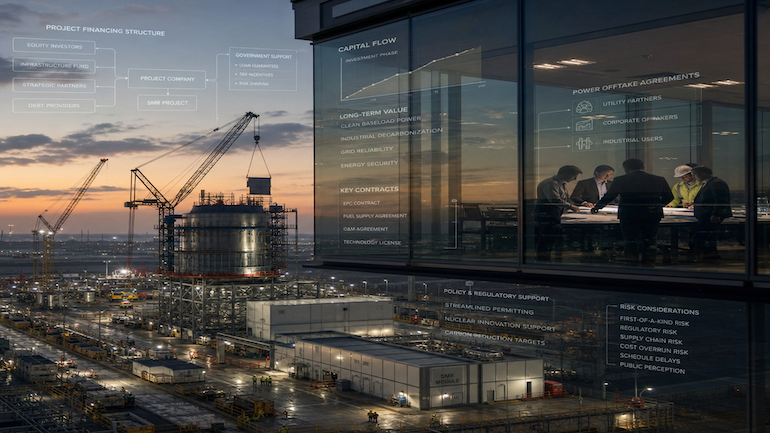
Robust policy frameworks are essential to reduce risk for investors, but they have to go beyond the usual streamlining of permitting and licensing processes. Funding or guarantees for FOAK units and policy frameworks that assign real value to firm clean power, offtake agreements, as well as subsidies or production credits, are key to addressing the urgent financing challenge while vendors establish a clear case for safety, cost, manufacturability, supply chain viability and regulatory acceptability.
Investors always need predictable revenue streams, and the role of offtake agreements, utility partnerships or industrial customers to enhance the bankability of SMR projects cannot be underestimated. At the same time, governments must use their policy levers to de-risk early projects, protect against cost overruns and support supply chain scale-up. At this critical phase of deployment, early successes or failures will have an exaggerated impact on the broader investment environment. Ultimately, that means sharing the risk to share the reward.


