

GlobalData’s latest report, ‘Russia Power Market Outlook to 2035: Market Trends, Regulations, and Competitive Landscape’, provides a comprehensive assessment of the Russian electricity sector.
The report analyses installed capacity in GW, electricity generation in Terawatt-hour (TWh), technology mix, and regulatory developments across the historical period from 2020 to 2025 and the forecast period from 2026 to 2035. It also evaluates market drivers, policy frameworks, infrastructure investment, and competitive dynamics using GlobalData’s proprietary databases, primary and secondary research, and in-house analytical expertise.

Access deeper industry intelligence
Experience unmatched clarity with a single platform that combines unique data, AI, and human expertise.
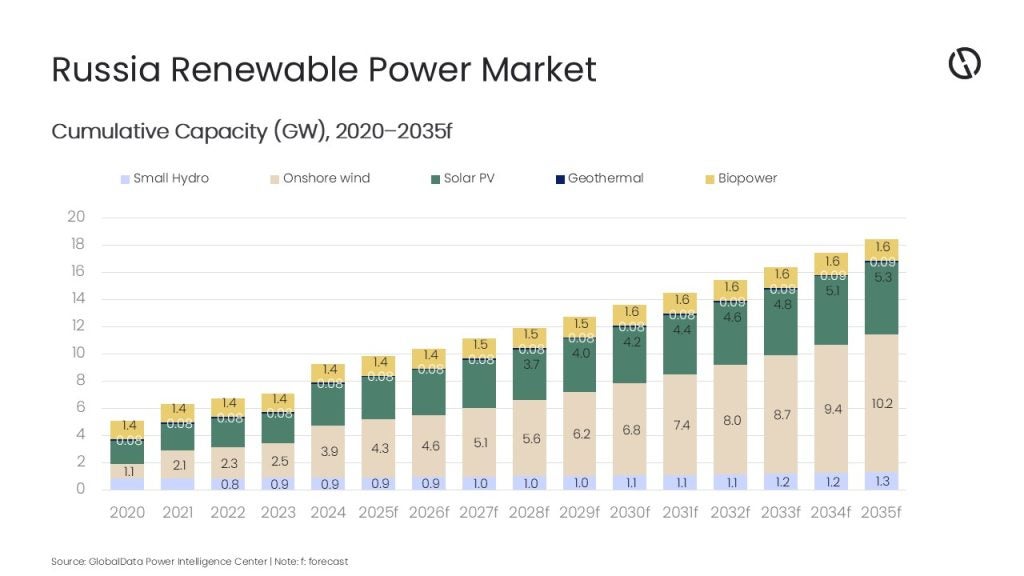
Russia operates a centrally coordinated electricity system structured around the wholesale electricity and capacity market, with thermal and nuclear generation forming the backbone of supply. While the country maintains a dominant reliance on natural gas and nuclear power to ensure system stability and energy security, renewable energy is gradually expanding under structured state-backed mechanisms. Within this framework, total renewable power capacity is projected to increase from around 9.8GW in 2025 to approximately 18.4GW by 2035, registering a compound annual growth rate (CAGR) of about 6.5% over the forecast period.
Renewable capacity growth is being implemented under the Capacity Supply Agreement framework for renewable energy, which provides selected wind and solar projects with fixed capacity payments for up to 15 years. This mechanism reduces exposure to wholesale price volatility and enhances long-term revenue predictability for investors. Domestic content requirements embedded within auction rounds support the development of local turbine assembly and solar module manufacturing, aligning renewable deployment with broader industrial policy objectives.
Onshore wind and solar photovoltaic technologies account for the majority of renewable additions through 2035. Installed onshore wind capacity is projected to increase from around 4.3GW in 2025 to approximately 10.2GW by 2035, supported by structured capacity auctions and localisation policies. Solar PV capacity is expected to rise from about 3.1GW in 2025 to nearly 5.3GW by 2035, driven primarily by utility-scale installations in southern and eastern regions where irradiation levels and grid infrastructure conditions are favourable.
Thermal generation continues to dominate Russia’s capacity mix, particularly natural gas, which represents the majority of conventional installed capacity. Gas-fired capacity is projected to increase from around 143.5GW in 2025 to approximately 151.2GW by 2035, reinforcing baseload supply and system reliability. Coal capacity is expected to gradually decline over the forecast period while oil-fired capacity remains largely stable. Nuclear capacity is projected to expand from about 26.8GW in 2025 to around 28.6GW by 2035, maintaining its strategic role within Russia’s centralised long-term energy planning framework.

US Tariffs are shifting - will you react or anticipate?
Don’t let policy changes catch you off guard. Stay proactive with real-time data and expert analysis.
By GlobalDataLooking ahead, renewable energy expansion in Russia is expected to proceed under phased auction rounds and continued localisation requirements, particularly for wind and utility-scale solar. Capacity additions are likely to remain structured and volume-controlled, with policy emphasis placed on domestic manufacturing development and selected regional deployment. While renewable capacity will continue to grow steadily through 2035, natural gas and nuclear generation are expected to remain central to overall system reliability and long-term energy security.
