
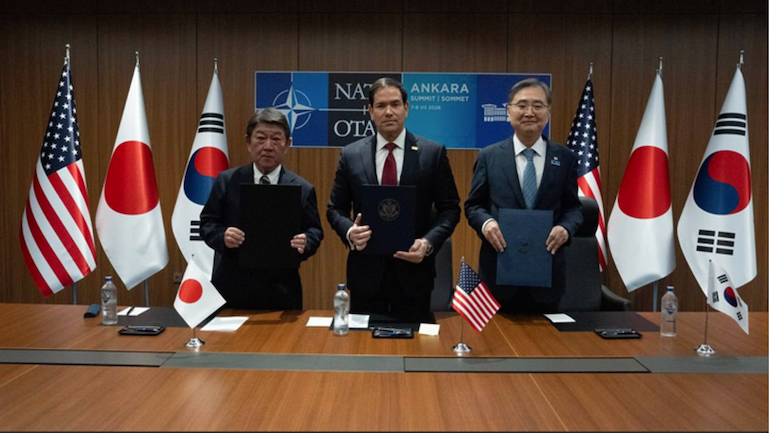
On the sidelines of the Nato Summit in Ankara, Türkiye, US Secretary of State Marco Rubio, Japan’s Foreign Minister, Motegi Toshimitsu, and South Korea’s Foreign Minister, Cho Hyun, signed a memorandum of cooperation (MoC) on small modular reactor (SMR) deployment.
The MoC establishes a framework for trilateral cooperation on accelerating SMR deployment in other countries, with an initial focus on the Indo-Pacific.
Go deeper with GlobalData


Discover B2B Marketing That Performs
Combine business intelligence and editorial excellence to reach engaged professionals across 36 leading media platforms.
“The MoC advances our mutual security interests and paves the way for partner countries to meet their energy security needs,” the US State Department said in a statement.
“The MoC outlines opportunities for our three countries, which have complementary advantages in the civil nuclear field, to encourage mutually beneficial cooperation among their respective nuclear industries.” This aims to foster fleet deployment models that de-risk project development, achieve economies of scale, catalyse private investment, streamline licensing processes and optimise supply chains.
The State Department said a coordinated trilateral approach positions US, Japanese and Korean companies to provide partners in the region with more competitive alternatives to meet their growing energy demands and to uphold the highest standards of nuclear safety, security and non-proliferation as new reactor technology comes online.
While the US can offer SMR reactor designs it has little experience in constructing nuclear power plants over the past few decades. South Korea, with world-class construction capabilities, complements this. Japan’s nuclear industry offers strengths in original technological capabilities and high domestic production rates for equipment.
Under the MoC, the three countries will identify third-party countries in the Indo-Pacific region that are interested in SMRs and support the construction of multiple SMRs through a standard fleet and simplified contracting procedures. For that purpose, the partners will encourage the formation of consortiums by their respective nuclear industries and foster project development by mobilising financing and investment.
In support of this initiative, the US is committing more than $10m in new funding for the Department of State’s Foundational Infrastructure for Responsible Use of Small Modular Reactor Technology (FIRST) Programme. This will “provide technical support to countries in [the] Indo-Pacific region for the deployment of safe, secure and reliable nuclear energy”. Funds will advance SMR project development activities and establish an SMR Regional Training Hub for workforce development.
The FIRST programme is a capacity-building initiative launched by the US Department of State’s Bureau of International Security & Nonproliferation (ISN) and now operating under the Bureau of Arms Control and Nonproliferation (ACN). According to the State Department, the ACN “executes the President’s America First Policy through a range of policies and targeted programmes. The Bureau advances US national security by preventing the proliferation of weapons of mass destruction, their delivery systems, destabilising advanced conventional weapons, and related technologies. This includes protecting and promoting US technological leadership through export controls and expanding the peaceful uses of US nuclear technology.”
While the official mission of the FIRST programme focuses on safety and clean energy infrastructure, the initiative is fundamentally a strategic instrument of US foreign policy. The primary political driver is pushback against the geopolitical leverage of America’s main competitors, namely Russia and China. Russia targets 20% of the global SMR market while China aims to export 30 reactors via its Belt and Road Initiative by 2030. By embedding Western standards into emerging economies early, the US aims to intercept these state-owned pipelines.
FIRST acts as a diplomatic shield, building a pathway for neutral or Western-aligned technology to prevent partner countries from being absorbed into rival spheres of influence. The nation that supplies the reactor typically dictates the non-proliferation, safety and security protocols of the host country. FIRST aims to ensure that international standards – specifically those championed by the US and the International Atomic Energy Agency – become the universal baseline.
The US also announced an industry initiative agreed upon among GE Vernova, Hitachi, Samsung C&T and SGE to advance deployment of the BWRX-300 SMR across Europe. This initiative will help achieve the ambitions set forth in the new MoC and deepen government-industry partnerships to strengthen global energy security.
GE Vernova Hitachi’s BWRX-300 is a 300MW-electrical water-cooled, natural circulation SMR featuring passive safety systems that leverages the design and licensing basis of GVH’s US Nuclear Regulatory Commission-certified ESBWR boiling water reactor design and its existing, licensed GNF2 fuel design. The first BWRX-300 is under construction at Ontario Power Generation’s Darlington site in Canada, with completion expected by the end of the decade.
Poland-based SGE is a co-investor in the standard design for the BWRX-300 and is in the process of establishing SMR partnerships and projects in a number of central and eastern European countries including Poland, the Czech Republic, Hungary, Bulgaria and Romania. Its flagship project is being implemented in Poland in collaboration with Orlen, with work under way at three sites and the first unit expected to be commissioned in 2032. SGE and a deployment team including Samsung C&T, Laing O’Rourke, Aecon Group and Google Cloud recently announced plans for the privately financed deployment of 14 BWRX-300 SMRs across three sites in the UK.


