

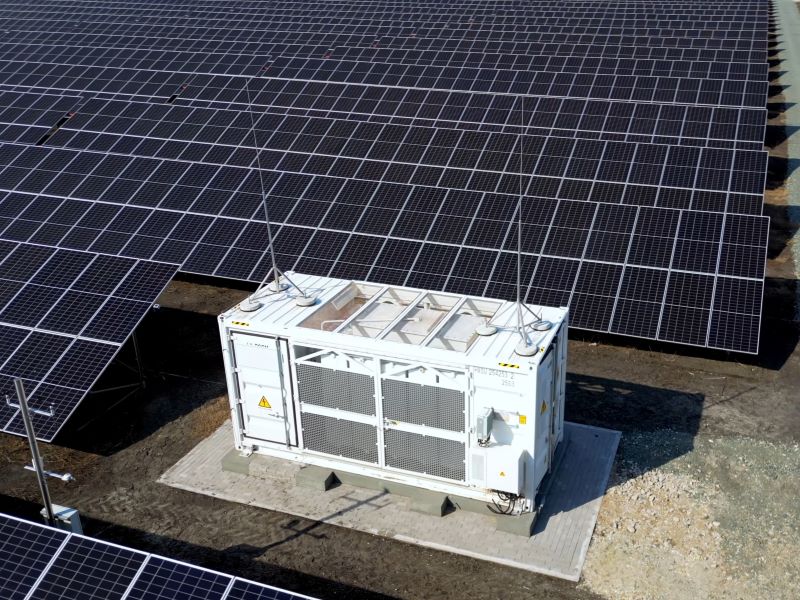
The Richmond Valley solar farm and battery energy storage system (BESS) is a 500MW/475MW-alternating current (MWac) BESS renewable energy project being developed in New South Wales (NSW), Australia, by Ark Energy, the Australian subsidiary of Korea Zinc.
Delivery of the project is planned in stages, with the first construction phase comprising a 200MWac solar farm alongside a 275MW/2.2GW-hour (MWh) BESS.
Recommended White Papers

Recommended Buyers Guides

Ark Energy took the final investment decision for the project in July 2026, putting the overall investment at around A$1.3bn ($908.5m). The financing includes A$586m in equity and A$716m in debt.
The project is expected to achieve financial close in September 2026, with construction starting the following month. Operations are targeted to commence in January 2029.
Richmond Valley solar farm and BESS location
The Richmond Valley solar farm and BESS project is located approximately 7km east of Rappville and 25km south of Casino, within the Richmond Valley Local Government Area in the Northern Rivers region of NSW, Australia.
The project covers an area of approximately 1,475 hectares (ha) (3,644 acres), with a maximum development footprint of 803ha spread across ten lots. It is in a mainly rural setting adjoining Bungawalbin State Forest to the east and spans two freehold properties that have historically been used for commercial forestry.
Development background
The Richmond Valley solar farm and BESS project secured a Long-Term Energy Service Agreement (LTESA) in December 2023 under the NSW Electricity Infrastructure Roadmap incentive scheme and was added to the Australian Government’s National Renewable Energy Priority List in March 2025.
Planning consent was issued by the NSW Government in October 2025, followed by environmental approval by the Australian Department of Climate Change, Energy, the Environment and Water in December 2025.
In June 2026, Ark Energy received approval to connect to the National Electricity Market.
Richmond Valley solar farm and BESS details
The solar farm section of the project is expected to deploy up to 730,000 bifacial photovoltaic modules in an east-west single-axis tracking layout, reaching up to 4m above ground level at maximum tilt.
The battery system is planned as outdoor containerised units grouped within a single central compound adjacent to the substation and switching substation, providing around 275MW of power and 2,200MWh of storage over eight hours. Up to 118 inverter stations are due to be installed to convert the generated output from direct current to alternating current.
The on-site electrical systems are set to include a 330kV/33kV switching substation and a 330kV substation serving both the solar farm and the BESS, supported by underground conduits and cabling. The underground cable reticulation within the site will connect the solar arrays and associated infrastructure to feed power into the on-site substation.
Around 2km of new transmission line is set to be installed to link the on-site substations to the Transgrid Lismore–Coffs Harbour 330kV transmission line, Line 89.
Supporting infrastructure works are expected to include the installation of temporary construction facilities, an operations and maintenance facility, internal roads, civil works and other required electrical installations.
Contractors involved
Hanwha Energy, a global renewable energy services provider, signed a supply agreement with Ark Energy in March 2025 to provide the battery systems for the project.
Elecnor Australia, a renewable energy and transmission engineering, procurement and construction company, was contracted by Ark Energy in September 2025 with an Early Contractor Involvement. The scope of work includes site assessments and the full detailed design for the solar farm, along with balance-of-plant engineering for the BESS. It also includes structural sign-off, preparation of management plans and support with permitting.
Ark Energy appointed Turnbull Engineering as the primary civil and structural reference designer. The scope has since broadened to cover detailed design and construction support for upgrades to public roads.
Aurecon, Turner & Townsend, Aon, CMW Geosciences and Herbert Smith Freehills Kramer are some of the other contractors involved in the project.
