

Advancing the Agentic World, Inspiring Intelligent Brazil brought together customers, partners and technology leaders to discuss how organisations can scale AI while addressing governance, cost, resilience and data control.
The atmosphere at the summit on October 29th at the Mercado Livre Arena Pacaembu, São Paulo, reflected a market moving beyond general interest in generative AI, with the focus not simply on access to large language models, but on creating the infrastructure, platforms, skills, and operating models needed to use AI safely at enterprise scale.
To support this goal, Huawei is building on its 28-year presence in Brazil to bring together local infrastructure, models, AI agents, security, and industry expertise to support enterprise AI innovation and the country’s intelligent transformation.
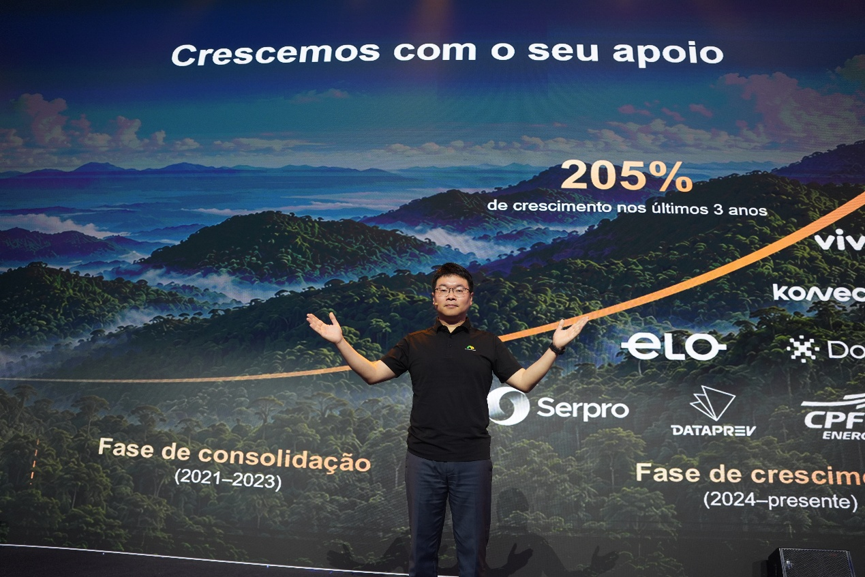
Jacky Gao, CEO of Huawei Brazil explained that Huawei Cloud has grown by 205% in Brazil over the past three years, with its Model as a Service (MaaS) now serving more than 100 leading local enterprises. “As AI moves beyond experimentation and into real-world business applications, Huawei Cloud will continue to enhance AI capabilities, strengthen ecosystem collaboration, and provide secure, easy-to-use cloud platforms and localised services, to help Brazilian businesses turn AI into business value,” Gao said.
Building an agentic cloud for enterprise adoption
A central theme of the event was the move towards agentic AI. While generative AI can create content or respond to prompts, AI agents are designed to complete multi-step tasks, interact with systems, use tools, and operate within defined business processes. For enterprises, the opportunity lies in embedding these capabilities in functions such as customer service, software development, finance, operations, compliance, and office administration.
Tim Tao, President of Huawei Cloud Computing Solution Sales, described the company’s approach as an Agentic Cloud, combining cloud services, models, agent platforms, deployment choices, and partner solutions.
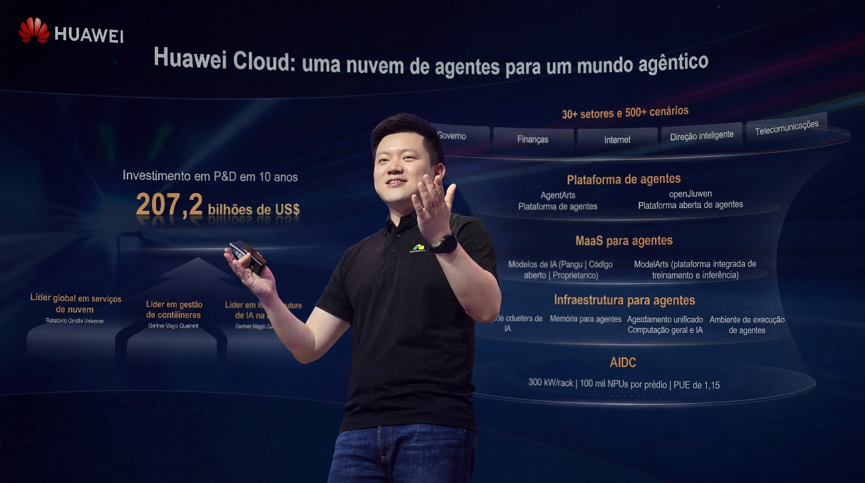
“Huawei Cloud is building an Agentic Cloud for the agentic era,” Tao said. “By combining innovative cloud services, diverse AI models, an enterprise-grade agent platform, flexible deployment options, and a strong partner ecosystem, Huawei Cloud aims to lower the barrier to AI adoption and accelerate the large-scale deployment of AI agents.”
The underlying infrastructure forms an important part of that proposition. Huawei Cloud operates 103 availability zones across 34 regions worldwide and says it has more cloud nodes and broader coverage than any other provider in Latin America. In Brazil, it established a local three-availability-zone (3-AZ) deployment in 2024 to support low-latency access and high-availability services. The company also highlighted its 3D data centre architecture, which increases the power capacity of a single rack from 80 kW to 300 kW, as well as its next-generation Atlas 950 AI cluster service, which it says can provide throughput of up to five million tokens per second to support large-scale concurrent agent workloads and ultra-long context processing. The challenge is not only to run a model, but to provide sufficient compute capacity, reliable service recovery, secure connectivity, and governance as AI becomes integrated into critical workflows.
Huawei Cloud MaaS also brings together large language and multimodal models, including DeepSeek, GLM, and Kimi. The platform provides access to models with context windows of up to one million tokens, supporting complex AI workloads. AgentArts then provides the environment for enterprises to build, orchestrate, and manage AI agents. Practical examples of the agent approach include CodeArts, which uses specialised agents to support software development workflows, and OfficeAce, which assists with routine office tasks such as document creation, data analysis, email and scheduling.
These examples brought the discussion back to a central concern for business leaders: whether AI can remove operational friction and improve productivity in work that employees undertake every day.
Four priorities for the enterprise AI transition
Vitor Zhu, President of Huawei Cloud Brazil, set out four priorities intended to support long-term enterprise transformation. Together, they address the full journey from AI experimentation to production deployment:
1. End-to-end AI capabilities, from compute to governance
Huawei Cloud’s first priority is to integrate AI across the technology stack. Combining infrastructure, models, data, development tools, security and applications from different providers can cause fragmentation, slow deployment and complicate risk management.
By connecting computing infrastructure with model development and fine-tuning, agent orchestration, governance and security, Huawei Cloud aims to help enterprises build and manage AI agents without assembling each layer separately.
AI agents can be applied to functions such as finance, government, energy and retail, where AI must work with existing systems and meet strict requirements for resilience, traceability and compliance. The goal is to move from proof of concept to repeatable, industry-specific deployment.
2. Dedicated local cloud for sensitive and regulated workloads
The second priority is data residency, control and isolation. As organisations use AI with sensitive data and critical processes, data location and governance become increasingly important.
Huawei Cloud Stack Online (HCSO) is designed to run in a customer’s data centre, keeping data within its environment to support security, governance and compliance. It offers more than 100 cloud services, including GaussDB, ModelArts and DataArts, and supports workloads from virtual machine migration and database transformation to mainframe modernisation and AI adoption.
This enables organisations to modernise in stages, maintain continuity and introduce cloud-native and AI capabilities at a pace that meets operational and regulatory requirements.
3. Flexible multicloud deployment with cost discipline
The third priority recognises that Brazilian enterprises will continue to use public cloud, dedicated platforms and on-premises infrastructure.
Huawei Cloud offers public cloud, HCSO and Huawei Cloud Stack, alongside support for migration, modernisation and AI deployment. Its local team provides consulting, implementation, migration, operations and AI services, including data engineering, model tuning and agent development. FinOps services support continuous optimisation of cloud spending as AI workloads grow.
4. Partner ecosystems and local capability building
The fourth priority is building a partner ecosystem for practical cloud and AI adoption. Brazilian partners are developing solutions for mainframe modernisation, core banking, multicloud connectivity, Portuguese-language models, multimodal applications, AI governance, agents, retrieval-augmented generation and workflow orchestration.
Collaboration spans six areas: security and compliance, industry solutions, cloud services and delivery, AI application modernisation, agents and workflows, and document AI. This network combines technology with local expertise and ongoing implementation support.
From AI experimentation to business value
The summit’s underlying message was clear: Brazil’s AI opportunity will not be defined by model performance alone. It will depend on whether organisations can deploy AI securely, with local governance, at a manageable cost, and in ways that support real business processes. Huawei Cloud is responding with local infrastructure, dedicated deployment options, model access, AI agent platforms, multicloud management and ecosystem support.
For enterprises, turning AI experiments into measurable business value will depend on connecting innovation with operational needs. Huawei Cloud’s four priorities, AI capabilities, local cloud services, multicloud flexibility and partner ecosystem, offer a framework for that transition.
