


G job postings ran at ten to twenty times their pre-October 2025 run rate through Q1 2026. By May, the aggregate volume was normalising. That normalisation, however, is not evenly distributed. The cross-sectional dispersion in YoY hiring change across the top ten operators is wider than at any point in the prior twelve months. Dispersion, not level, is where the actionable signal sits.

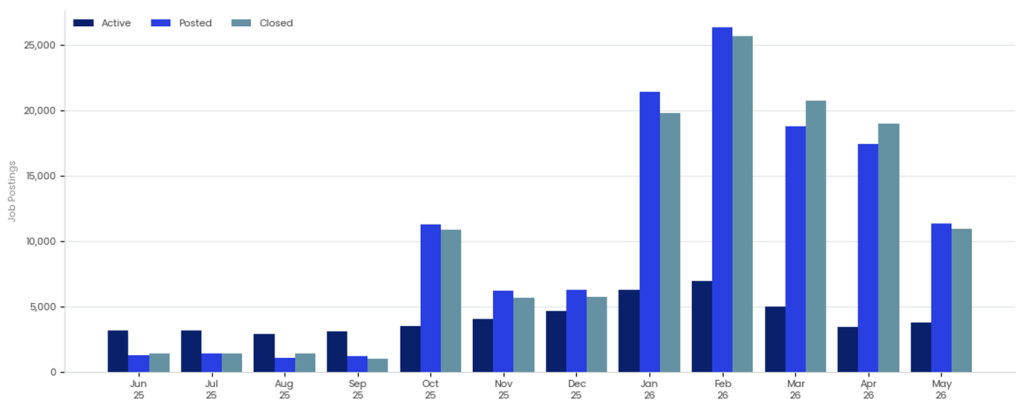
LNG posted job volumes ran at 1,000 to 1,400 per month through mid-2025. In October 2025, volumes inflected sharply upward, from 1,208 to 11,265 in a single month, a tenfold step-change with no prior-year precedent. The expansion continued through February 2026, peaking at 26,303 posted roles. Closed postings tracked posted volumes with a one-month lag, confirming genuine throughput rather than posting accumulation.
By May 2026, posted volumes have retraced to 11,323, down from the February peak but still 605% above the year-ago comparable. Active postings at 3,762 are up 12% YoY. The retracement from the peak is mean-reversion; the YoY base effect is structural. A sector operating at six times its prior posting rate, even after normalisation, is not the same sector it was twelve months ago. The residual level after the surge is where the capacity signal lives.
Figure 1: Monthly Active, Posted & Closed Job Postings — LNG, Jun 2025–May 2026
Source: GlobalData Jobs Analytics
The factor is in the spread, not the mean
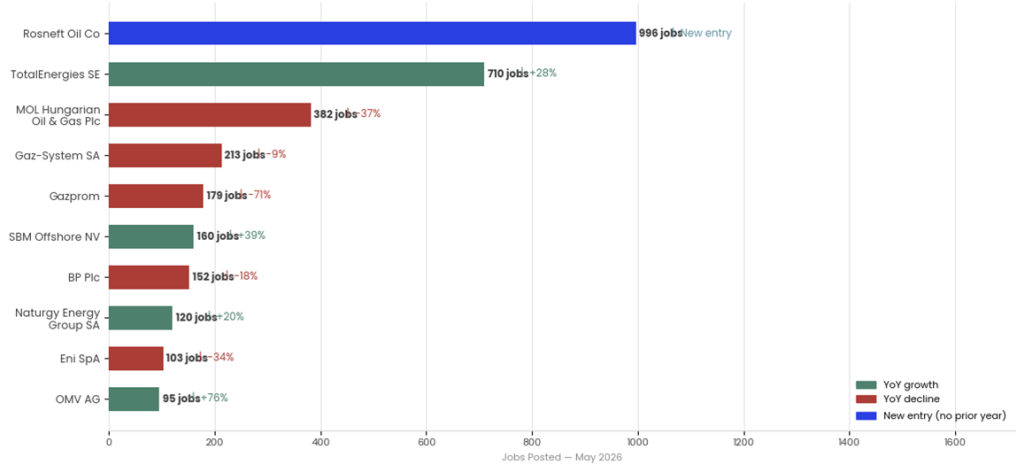
The aggregate sector number conceals a cross-sectional range that is analytically more useful than the mean. At one end: OMV AG up 76% YoY, SBM Offshore up 39%, TotalEnergies up 27%, operators expanding posting volume against a normalising backdrop. At the other: Gazprom down 71%, Eni down 34%, MOL down 37%. That is a 147-percentage-point spread between the top and bottom performers in a ten-name universe. In a factor context, the long-short signal embedded in that dispersion is the position; the aggregate is noise.
Rosneft enters the top ten from zero, with 996 posted roles in May 2026 and no prior-year comparable. New entrants at that volume in a normalising month are not filling routine vacancies; they are initiating a hiring programme. The names running counter to the mean, OMV, SBM, TotalEnergies and Rosneft, are the ones worth isolating. A portfolio screen built on aggregate LNG hiring will miss all of them.
Figure 2: Top Companies by Jobs Posted — LNG, May 2026 vs May 2025
Source: GlobalData Jobs Analytics
Revealed capital allocation vs staffing decisions
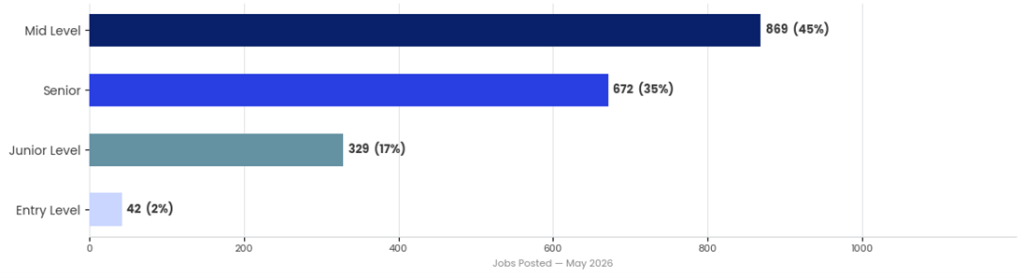
The seniority composition of May 2026 LNG postings is upper-band skewed to a degree inconsistent with operational backfill. Senior roles account for 35% of postings, mid-level for 45%, and entry-level for just 2%. In a sector characterised by three-to-five-year project cycles, a senior hire today is productive capital allocated against a project that has already been sanctioned. The seniority profile does not describe what operators need now; it describes what they have already committed to.
Read alongside the dispersion in volume, seniority is a second dimension of the same signal. Operators growing their posting volume and skewing toward senior hires are simultaneously expanding capacity and pre-loading the expertise required to execute it. A single-factor screen on volume will rank Rosneft first. Adding seniority as a second factor changes the ranking. Both dimensions are necessary to locate where genuine strategic commitment is being expressed, rather than where aggregated posting counts are simply highest.
Figure 3: Seniority Mix of Jobs Posted — LNG, May 2026
Source: GlobalData Jobs Analytics
The European ex-Russia signal is clean
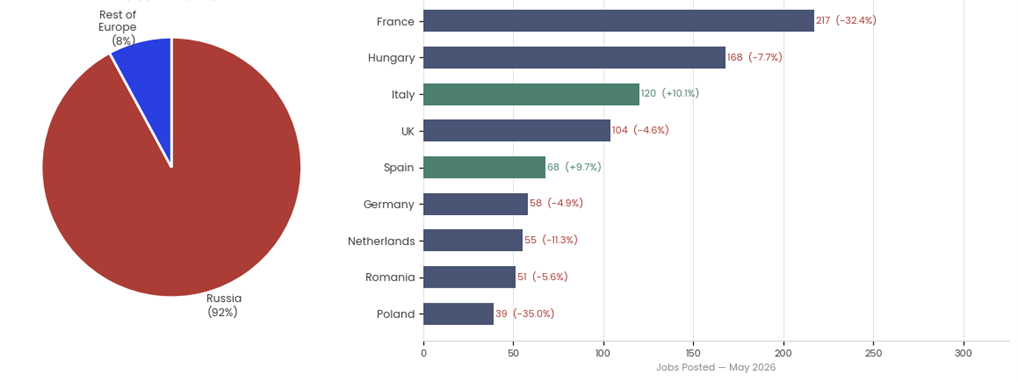
Russia accounts for 10,260 of 11,140 posted jobs in the geographic breakdown, 92% of the total, driven almost entirely by Rosneft’s 10,219-posting footprint. The average job duration in Russia is three days, against 20 to 27 days across all other geographies. A three-day average duration is not consistent with a conventional recruitment posting cycle. It is a data artefact of how Rosneft’s postings are aggregated and should be isolated before drawing geographic inferences. The Russian volume is a Rosneft-specific event, not a market signal.
Ex-Russia, the European geographic picture has low cross-sectional dispersion but directionally informative skew. Italy (+10%) and Spain (+10%) are the only markets with positive month-on-month growth; France (-32%) and Poland (-35%) are the sharpest decliners. The UK is flat at 104 postings with a 21-day duration, a stable, institutional hiring cadence. With the ex-Russia universe geographically concentrated in Western Europe and operating against a homogeneous regulatory backdrop, cross-company comparisons are less contaminated by country-level macro variance than the headline geography suggests.
Figure 5: Jobs Posted by Geography — LNG, May 2026
Source: GlobalData Jobs Analytics
What this means for LNG leaders
The cross-sectional dispersion in LNG hiring, a 147-point range between OMV and Gazprom on a YoY basis, is not visible in commodity prices, reserve disclosures or consensus earnings estimates. It surfaces in job postings first, and by the time it surfaces in filings, the positioning interval has closed. The combination of volume direction, seniority skew and thematic composition across individual operators produces a multi-factor signal that ranks companies differently than any single-variable screen.
The ten operators visible in this dataset are the largest by posting volume, but the full universe of LNG operators is substantially wider. A systematic read of hiring intent across that universe — with seniority, thematic, and geographic decomposition at the company level — is what converts a data point into a durable, repeatable factor.
GlobalData Jobs Analytics captures point‑in‑time postings directly from company career pages, tagged by company, sector and theme. To see this in practice, request a data sample today by contacting hirendra.vikram@globaldata.com and download the white paper below to start turning complex hiring patterns into clear signals you can use in planning and investment decisions.
