

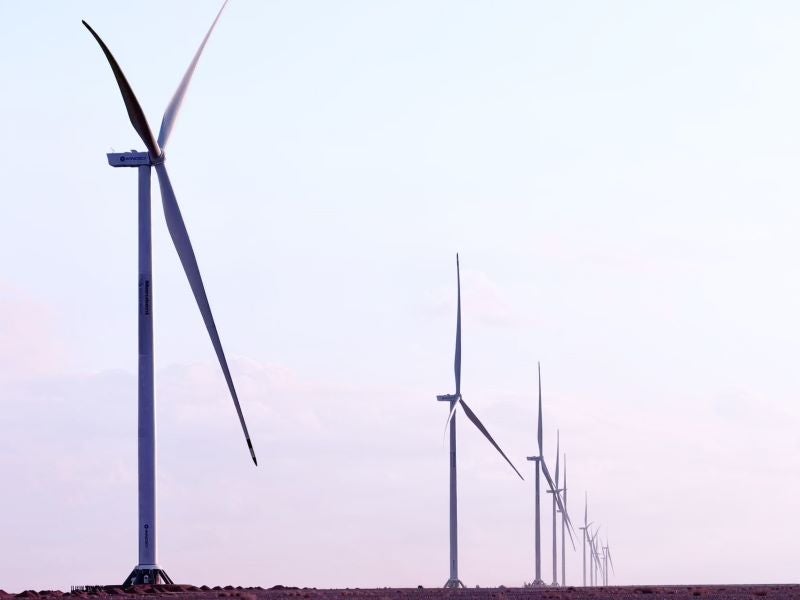
The Yanbu wind power project is a 700MW onshore wind farm under development in Saudi Arabia’s Al Madinah Province.
The SR1.7bn ($458m) scheme is being implemented as an independent power project by Riyah Al Sahil Company (Al Sahil), a joint venture between Japan-based Marubeni, which holds a 51% stake, and Saudi Arabia’s Ajlan & Bros, which holds 49%.
Recommended Buyers Guides
Yanbu is part of Round 4 of renewable projects under Saudi Arabia’s National Renewable Energy Programme (NREP), overseen by Saudi Arabia’s Ministry of Energy (MoE). The programme supports the Kingdom’s target of around half of total power generation capacity to be met by renewable energy and energy storage systems by 2030, subject to electricity demand growth.
The wind power project achieved financial close in January 2026. The contract for the supply of steel wind towers was awarded in April 2026.
Location
The Yanbu wind power project is located approximately 50km north-west of Yanbu city, on the Red Sea coast in the Al-Madinah Al-Munawwarah Province of western Saudi Arabia. The largely undeveloped site covers an area of around 103km².
The site was selected based on prevailing meteorological conditions and the physical characteristics of the area.
Development background
The wind farm’s original capacity was set at 850MW. This was later revised to 700MW following evaluation of the technical and economic submissions.
The MoE defined revised site boundaries and constraint conditions for the project in the fourth quarter of 2020 (Q4 2020).
The environmental and social impact assessment (ESIA) was subsequently updated in Q2 2021, and approval was granted by the Saudi National Centre for Environmental Compliance (NCEC) in line with applicable national regulations.
Based on the NCEC’s response to the project’s environmental classification form, the scheme was designated as Category 3, and the environmental permit was issued in March 2023.
Yanbu wind power project make-up
The Yanbu wind power project will comprise 87 Windey WD200-7700IW three-blade wind turbines, which are designed for operation in the Middle East’s high temperatures and dusty conditions. Each unit has a rated capacity of 7.7MW, a rotor diameter of 200m and a hub height of 115m.
The turbines incorporate three-point support drive chain systems, an intelligent monitoring system, a built-in cabinet transformer and precision dynamic load control.
In addition, the turbines feature enhanced cooling and anti-condensation systems, and are designed to operate in temperatures ranging between -40°C and 45°C.
The turbine blades feature a wear-resistant and sand-proof protection film as well as a brush seal and dust filter in key areas.
Tubular steel towers will serve as the primary support structures for the wind turbines.
Grid connection
The wind farm’s output will be evacuated through the 9GW NEOM-Yanbu high-voltage direct current transmission line, which is set to extend Saudi Arabia’s power grid from the Yanbu region to the NEOM Industrial City (NIC).
A switching substation will be built on the site and linked to nearby existing transmission lines.
The transmission infrastructure for the project will be developed, owned and operated by the Saudi Electricity Company.
Power purchase agreement
Principal Buyer, the Saudi Power Procurement Company, signed a power purchase agreement (PPA) with Al Sahil for the Yanbu wind power project in July 2025.
Signed under the NREP, the PPA runs for 25 years and specifies a levelised cost of electricity of SR0.064/kW-hour (kWh) ($0.017/kWh).
Yanbu wind power project financing
The Yanbu wind power project has secured financing of $305m from a consortium of banks led by the Japan Bank for International Cooperation (JBIC), which is providing $152m (Y23.79bn).
The other banks involved in the financing are Sumitomo Mitsui Trust Bank, Standard Chartered Bank and Bank of China.
Contractors involved
The original ESIA report was prepared by John Wood Group (Wood), an engineering consulting company. WSP, an engineering and professional services consultancy, acquired the Environment & Infrastructure business of Wood in 2022 and amended the ESIA based on requirements outlined by JBIC.
Windey Energy Technology Group, a wind turbine manufacturer based in China, is supplying wind turbines for the project.
SEPCO III Electric Power Construction Company (SEPCO), a subsidiary of PowerChina, is the engineering, procurement and construction contractor for the wind farm.
Al Yamamah Steel Industries, a steel manufacturing company, is supplying steel wind turbine towers for the project under a SR126m, nine-month contract awarded by SEPCO in July 2025.
Operis, an independent advisor in project finance and financial modelling, carried out a financial model audit in support of the project’s financial close. Herbert Smith Freehills and Kramer, a law firm, advised the developers on legal matters related to the Yanbu wind power project.
