

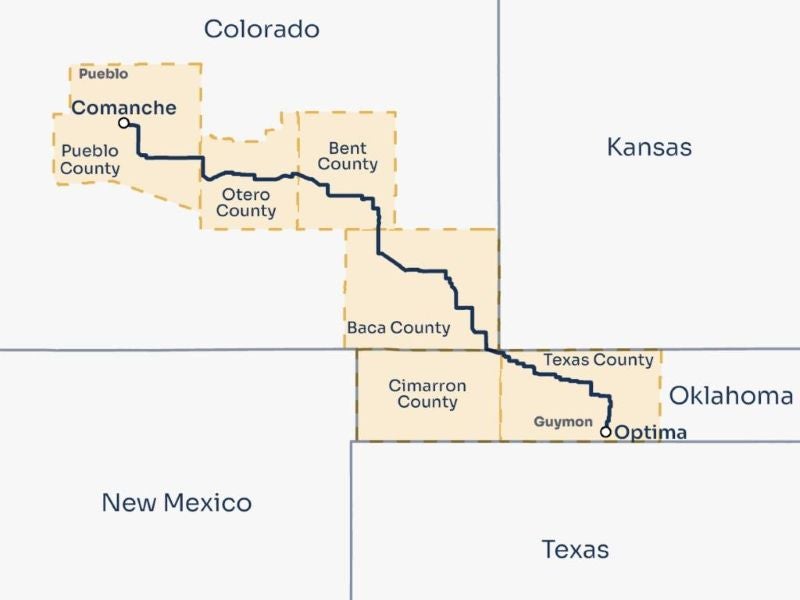
Three Corners Connector is a 483km-long high-voltage direct current (HVDC) transmission line project being developed by Grid United.
The project is intended to connect the US eastern and western electricity grids and transmit electricity from all sources in either direction along the line in response to demand.
Recommended Buyers Guides

The transmission line is estimated to require an investment of approximately $2.1bn.
Construction is planned to begin in 2027, with operations expected to start in 2031.
Development background of Three Corners Connector
The Three Corners Connector was established in 2022, and the route for the project was evaluated in the same year. Engagement with landowners and other stakeholders began in mid-2022, alongside work to secure transmission line easements, which continued until late 2025.
Transmission line design and engineering began in 2022 and are scheduled to continue through 2027.
Three Corners Connector submitted a 1041 permit application to Pueblo County in late 2025. The application remains under review by the county and relevant agencies. The project received its 1041 permit from Otero County in February 2026 and its Special Review Use Permit from Bent County in late July 2026.
In January 2026, Three Corners Connector applied for a Certificate of Authority from the Oklahoma Corporation Commission (OCC). The certificate is intended to provide the primary state-level siting and public-interest approval, as well as ongoing oversight by the OCC.
Three Corners Connector project details
The Three Corners Connector project will extend from an existing substation in Pueblo, through southeastern Colorado to a proposed substation near Guymon, Oklahoma.
The project is designed to operate at 525 kilovolts (kV) and will have a 1,800MW transmission capacity. This will more than double the existing 1,320MW transfer capacity between the Eastern and Western Interconnections.
Two converter stations are proposed to be constructed for the project, one near each endpoint in Colorado and Oklahoma, to convert electricity between alternating current (AC) and direct current (DC).
The converter stations are expected to share a common design, including a valve hall, converter transformers and cooling equipment. They will also feature an AC yard, control building, spare parts building and backup generator.
The proposed converter station in Pueblo County, Colorado, would occupy a 20-acre fenced facility within a 40-acre tract. Its valve hall would be approximately 75ft (23m) to 100ft (100.5m) high. The transmission line will enter the site from the south and exit to the north.
Construction of each station is expected to take approximately three to four years and will include ground works, building construction, and electrical installation. Specialised lighting techniques are planned to reduce light pollution.
Financing for Three Corners Connector project
In October 2026, the US Department of Energy (DOE) selected the project to enter negotiations for a final funding award through the Speed to Power through Accelerated Reconductoring and other Key Advanced Transmission Technology Upgrades (SPARK) programme.
The Oklahoma Office of Management and Enterprise Services applied for up to $250m in federal funding via the SPARK programme, with Three Corners Connector named as a subrecipient, to support delivery of the transmission line.
Three Corners Connector project benefits
By increasing transfer capacity between the two power grids, the Three Corners Connector project is intended to support electricity supply during periods of high demand, improve grid resilience, and reduce the effects of extreme weather events on system reliability.
Contractors involved
Environmental consulting company SWCA provided environmental consulting services for the project. The scope of work included environmental and cultural services, including archaeological, built environment, and viewshed investigations.
The project is estimated to generate more than $4bn in direct savings for ratepayers in Colorado and Oklahoma over 40 years. It is also expected to provide tax revenue, payments to landowners, and temporary and permanent employment.
