
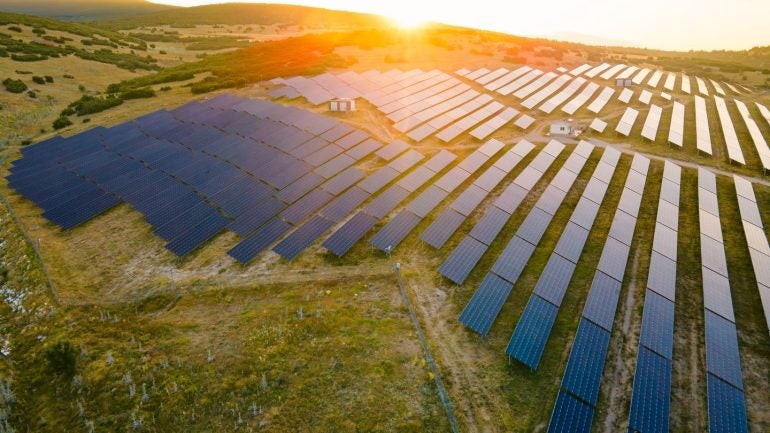
Lithuania-based energy company Ignitis Group has announced that its subsidiary, Ignitis Renewables, has commenced commercial operations at the 173.6MW Tume solar farm in Latvia.
The project, located in Tukums municipality, is said to be one of the largest solar energy projects in the Baltic region.
Go deeper with GlobalData


Discover B2B Marketing That Performs
Combine business intelligence and editorial excellence to reach engaged professionals across 36 leading media platforms.
The solar farm covers 302ha and is equipped with more than 282,000 solar panels.
According to Ignitis Group, the facility is expected to provide enough electricity to meet the demand of approximately 85,000 households.
The project will support local renewable energy production and contribute to regional energy security in Latvia.
Investment in the Tume solar farm will total up to €106m ($119m).
In a further development, Ignitis Renewables is constructing a battery energy storage system (BESS) at the site.
The 107.2MW/214.5MWh Tume BESS is designed to be integrated with the solar farm and aims to improve its operational efficiency and flexibility.
In July this year, Ignitis Group made a final investment decision (FID) regarding the Tume BESS.
Following the start of commercial operations at Tume, Ignitis Group’s installed green capacities have increased to 2.3GW, up from 2.1GW.
In October 2025, the European Bank for Reconstruction and Development (EBRD) lent €79.5m ($92.3m) to Ignitis Group to support the construction of the largest onshore wind farm in the Baltic region.
The loan formed part of a total €318m financing package, which was intended to strengthen Lithuania’s energy security and advance the country’s transition to green energy.
The comprehensive financing included contributions from the European Investment Bank, Swedbank, and the Nordic Investment Bank. This funding enabled Ignitis Group to complete its 314MW wind farm project in Kelmė, located in western Lithuania.
Once operational, the Kelmė wind farm generates 740GWh of zero-carbon electricity a year, enough to supply approximately 250,000 households.


