
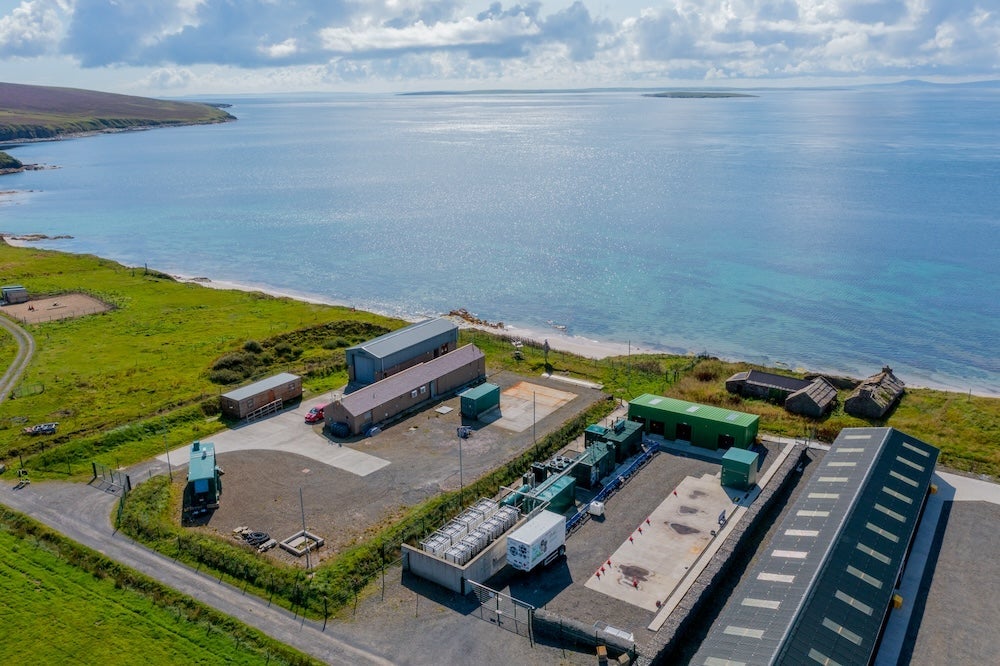
The European Marine Energy Centre (EMEC) has completed what it says is the first demonstration of a fully integrated tidal power, battery storage and hydrogen production system. The trial was carried out at EMEC’s onshore site on Eday, Orkney, Scotland.
The project linked Orbital Marine Power’s O2 tidal turbine, vanadium flow batteries from Invinity Energy Systems and an ITM Power 670kW electrolyser. EMEC tested multiple operating modes, using high-generation tidal periods to charge the battery system, supply the electrolyser and export power to the grid. When tidal output fell, the battery discharged to keep the electrolyser running.
According to EMEC, the trials showed how battery storage can smooth the predictable but cyclical nature of tidal generation, allowing continuous electricity supply for hydrogen production and supporting operations at the site. It is the first time the three technologies have been combined into a single system.
All planned scenarios were completed, including safety tests. EMEC said operators were able to respond within seconds to an electrolyser trip to avoid a full shutdown. The demonstration highlighted where control systems and automation could be improved, including battery management and electrolyser performance.
The work formed part of the Interreg North-West Europe–funded ITEG project, aimed at exploring how tidal power and hydrogen production can be used in locations with limited grid capacity. Additional support came from the Scottish Government through Highlands and Islands Enterprise and the EU-funded FORWARD2030 programme.
Graeme Harrison, head of Marine Energy at Highlands and Islands Enterprise, said the demonstration shows how “the highly predictable flows of power from tidal streams can be successfully harnessed in a variety of forms to meet the energy needs of business and communities throughout Scotland and beyond”.
EMEC’s operations and maintenance manager, Leonore Van Velzen, said the work “represents the culmination of years of effort to integrate tidal energy, battery storage and hydrogen production”, adding that running all scenarios and reacting quickly to equipment trips “have given us a clear road map for optimising future systems”. She said the approach could be useful where grid export capacity is limited and noted that EMEC is now exploring synthetic fuel production from renewable hydrogen.
Invinity Energy Systems CEO Jonathan Marren said the project “showcases the strengths of our vanadium flow battery technology as a high-cycling, non-degrading and fundamentally safe form of long-duration energy storage”, adding that the results prove its suitability for both hydrogen production and “tidal power firming”.
Orbital Marine Power CEO Andrew Scott said the demonstration shows how tidal energy can be maximised through storage. “By maximising generation through battery storage, we minimise curtailment and enable industrial offtake that can achieve higher decarbonisation,” he said, noting the relevance for grid balancing and coastal communities as the sector expands.