

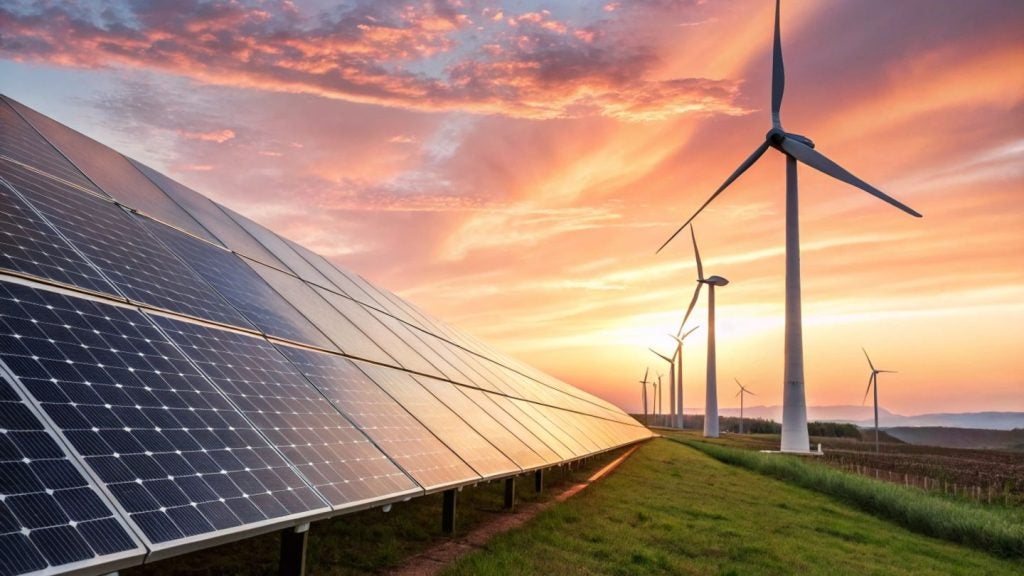
India has reached a significant milestone in 2025 by adding 50 gigawatts (GW) of renewable energy capacity, supported by nearly Rs2tn ($22.32bn) in investment, reported PTI.
This expansion has raised the nation’s total non-fossil fuel capacity to around 262GW, putting India ahead of its climate commitments.
Non-fossil fuel sources currently comprise half of India’s installed capacity, meeting the Paris Agreement’s 2030 goal five years ahead of schedule.
The country’s total installed power capacity currently stands at 510GW, including 247GW from fossil fuels and 262GW from non-fossil sources, of which renewables account for 254GW.
Union Minister for New and Renewable Energy Pralhad Joshi told PTI that 2025 recorded unprecedented growth, with around 45GW of renewable capacity added from January to November, driven mainly by nearly 35GW of new solar capacity.
He said: “By the end of December, we will reach nearly 48-50GW. The future is sunny and will be powered by renewables,” noting that this momentum is likely to carry into 2026.
Despite the progress, hurdles such as land acquisition, right-of-way constraints, and delays in finalising power purchase agreements (PPAs) are still limiting the rollout of new projects.
Industry projections suggest capital costs of roughly Rs 40m per megawatt (MW), implying about Rs2tn for every 50GW of additional capacity.
An Indian Renewable Energy Development Agency (IREDA) analysis estimates that India will require around Rs30.54tn in investments from 2023 to 2030 to reach the 500GW non-fossil fuel capacity target.
Since 2014, public sector financial institutions have collectively committed about Rs10.79tn to renewable energy, including approximately Rs2.68tn in the 2024-25 fiscal year alone.
Pralhad Joshi stated that between 2014 and 2024–25, public sector banks and institutions, such as IREDA, PFC, REC, IIFCL, SIDBI, and NaBFID, have deployed around Rs10.79tn (excluding private banks) for renewable energy projects, of which about Rs2.68tn was invested in the financial year (FY) 2024-25.
According to Vinay Rustagi, chief business officer of Premier Energies, an integrated solar cell and solar module manufacturing company, 2025 has been an exceptionally active year for the renewable sector.
He noted that project commissioning increased by more than 50% compared to the previous year, largely propelled by the PM Surya Ghar Yojana and the PM-KUSUM programme.
Rustagi observed that the rapid scaling of renewable capacity is creating grid imbalances, leading to power curtailment, while delays in adding transmission infrastructure are hindering project timelines, especially in Rajasthan.
Hitachi Energy’s MD and CEO for India and South Asia, N Venu, emphasised the need to reinforce the transmission grid, speeding up the rollout of renewable energy zones, boosting energy storage, and moving from project-centric to programme-driven approaches.
Venu added that with targeted measures in 2026, India can improve its energy security and solidify its standing in the global clean energy arena.