


The debate about data centres is mostly a debate about demand: how much computing power AI will need, and who will pay for it. Far less attention goes to a simpler question: how quickly can the industry build what has been announced?
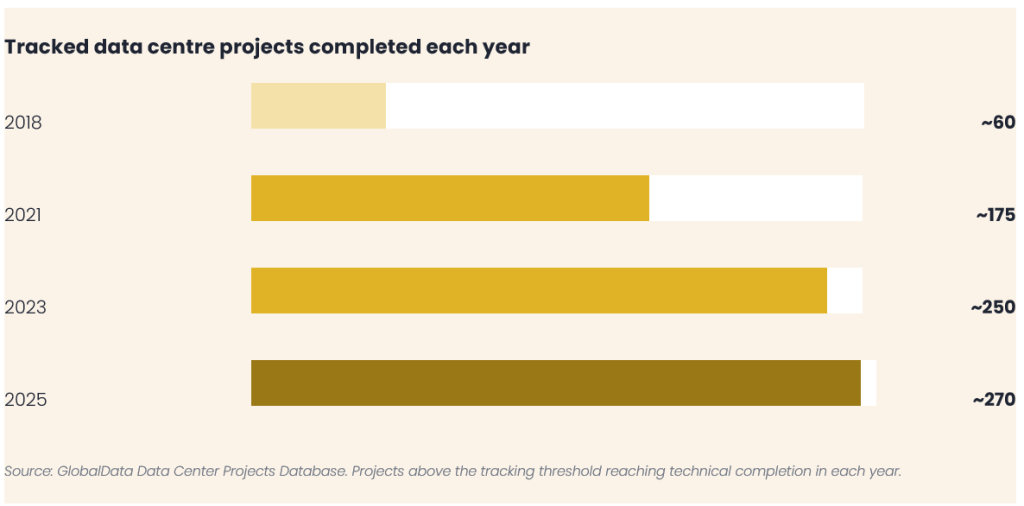
GlobalData tracks data centre construction projects around the world from announcement to completion, and the completion record shows an industry that has scaled up quickly. In 2018 around 60 tracked projects were finished. In 2025 the figure was roughly 270, more than four times as many. By the standards of any construction sector, that is rapid growth.
The pipeline, however, has grown faster than the industry’s ability to deliver it. There are now around 2,500 projects in active development worldwide, and if the industry keeps completing projects at its 2025 rate, working through that list would take about nine years. Measured against the average completion rate of the past five years, it would take closer to 11.
What the number really shows
The nine-year figure is a measure of capacity rather than a forecast, and it needs a few qualifications. Projects vary enormously in scale, so a simple count treats a hyperscale campus and a small regional facility as the same thing. Completion rates will also keep rising, and some of what has been announced will slip well beyond the current horizon, which shortens the queue without delivering anything.
What the figure does show is how far announcements have run ahead of the industry’s ability to deliver them. Every project in the pipeline needs a site with power, a main contractor, a specialist mechanical and electrical package and a workforce to install it. Those inputs are shared across the whole industry, and none of them can be scaled up at the speed that press releases imply.
Where the shortages are
The delays come down to a handful of physical shortages. Transformers, switchgear and high-voltage grid connections can take years to source, specialist mechanical and electrical contractors able to deliver at hyperscale are limited in number in any single market, and the commissioning engineers who bring a finished facility into service are scarcer still.
These are not shortages that money can solve quickly, because extra funding cannot conjure a transformer, and a well-capitalised sponsor competing with three others for the same contractor simply pushes the price up. In markets where several large projects are under way at once, that competition is already visible in tender prices.
Where the advantage sits
Supply chain companies are not all in the same position. Those selling the scarce inputs — electrical equipment, grid connection services, specialist installation — are selling into a market where demand will exceed delivery capacity for years, which supports prices as well as volumes.
Companies further down the chain only earn revenue once projects reach site. For them a long queue is a risk rather than an opportunity, because it describes work that has been announced but not yet released.
Which makes the useful test of any supplier a simple one: does it sell something the industry cannot currently get enough of?
Answering that test takes project-level records. GlobalData’s Data Centre Projects Database names the owner, main contractor and design firm on each of the roughly 2,500 developments in the pipeline, alongside stage and activity.
GlobalData’s free whitepaper, The Deliverability Gap, shows how much of that pipeline is genuinely deliverable by 2030. Download it below.
