

The 1,025MW Ras Laffan B combined-cycle power plant in Qatar has a seawater desalination plant that produces around 27,500 cubic metres of drinking water per day. Project construction began in September 2005 and the plant was officially opened in March 2008.
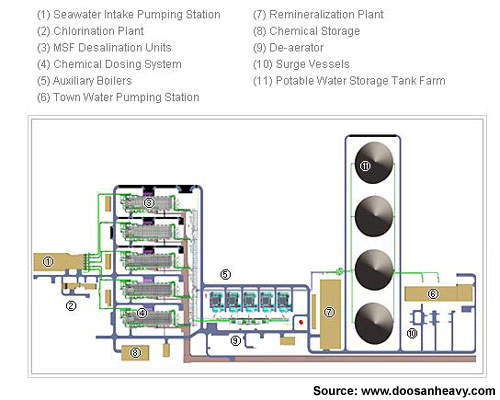
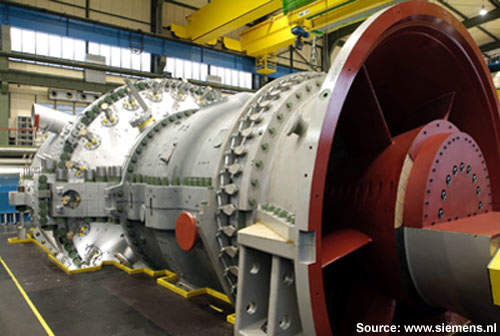
The plant has three Siemens SGT5-4000F gas turbines, two 220MW steam turbines steam turbines and four 15MIGD (million imperial gallons per day) multi-stage flash distillers. The desalination plant was supplied by Doosan Heavy Industries & Construction, with the drinking water being pumped to Doha.
Recommended White Papers
Recommended Buyers Guides

The plant was constructed by Q-Power, a Qatar Shareholding company incorporated with the participation of the Qatar Electricity & Water Company. The construction consortium comprised QEWC (55%), UK based International Power (40%) and Japan based Chubu Electric Power (5%). A $750m debt package involving 22 banks was finalised for Q Power.
The Ras Laffan B Power and the desalination plant were built at a cost of $900m.
Siemens’ SGT5-4000F gas turbines
The SGT5-4000F (formerly known as V94.3A) is the largest Siemens gas turbine. It has been enhanced with improved compressor and turbine aerodynamics to reduce emissions, improve operational flexibility and increase output.
The aerodynamic characteristics of the first two compressor stages and the inlet guide vane were modified to increase compressor inlet mass flow and enhance efficiency. The airfoil geometry was adapted to the existing flow channel and the rotor disc slots, so the new blades and vanes are fully retrofittable.
To adapt the turbine to the higher flow, the last stage blade was re-staggered by 1.5°. This was achieved by a simple casting change by turning the existing airfoil on the existing blade root. This can reduce aerodynamic losses without major requalification efforts for the modified casting and without significant changes to blade vibration behaviour.
Radial clearances in compressor and turbine sections have also been optimised by balancing warm-up and cool-down behaviour of the casing and rotor components.
The rotor is shifted in the compressor direction after the engine is fully heated to reduce the radial clearances by about a millimetre. The efficiency gain in the turbine is about 0.35%, much larger than the loss in the compressor section of about 0.15% due to slightly increased clearances.
Redesign of improved ceramic heat shield (CHS) material reduces service cost by lowering the fallout rate. Changes to operating parameters allow operation in premix mode even at turndown below 50% base load and within required emissions limits. A hydraulic clearance optimisation (HCO) system controls turbine blade-tip clearances, increasing both power and efficiency.
Further evolutionary improvements, especially in the field of combustor and burner technology, are in development.
Ras Laffan desalination plant
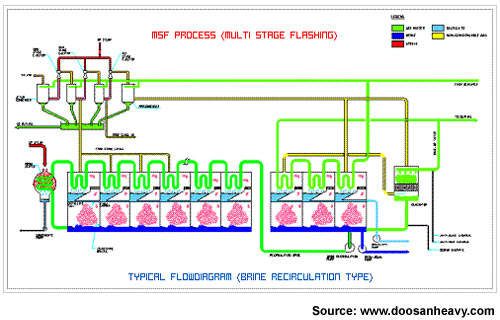
The desalination facility converts seawater into potable and industrial water.
There are three major desalination methods, MSF (multi-stage flash), MED (multi-effect distillation), and RO (reverse osmosis). With the MSF used at Ras Laffan, seawater is heated to produce steam, and the steam is condensed into water. The condensed steam is reused to heat the seawater that runs through the pipe.
The process is energy efficient and, because it operates in vacuum, produces a lot of water quickly. The Al-Shoaiba Desalination Plant in Saudi Arabia being constructed by Doosan, for example, produces 100 million gallons a day.
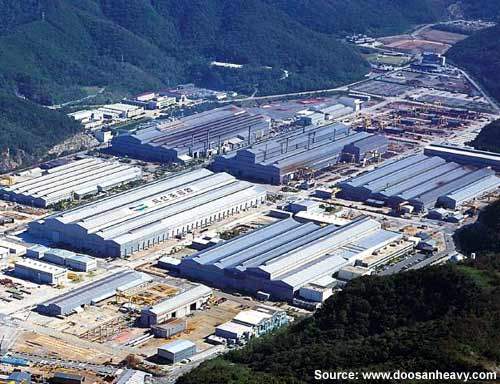
Doosan is exporting its MSF desalination facilities on a turnkey basis, from design and construction to start up. At present, Doosan’s world market share is about 25%. Most plants have been constructed in the Middle East, but it is expected that demand for this facility will increase in Korea and South East Asian countries, where water shortage is expected in the near future.
Plant history
The Ras Laffan Power Company was formed to build the first independent water and power plant (IWPP) in Qatar, following a 2001 Emiri decree. It is a joint venture between the US AES Corporation (which holds 55% of the equity), QEWC (25%), Qatar Petroleum (10%), and the Gulf Investment Corporation of Kuwait (also 10%).
The Ras Laffan A plant started operation in May 2004, generating 750MW electricity and 151 million litres per day of desalinated water at a cost of $720m. Ras Laffan has a 25-year power purchase contract with Kahramaa and a long-term gas supply contract with Qatar Petroleum.
The Ras Laffan C plant will provide 2,730MW of electricity and more than 286,000 cubic metres of desalinated water a day, making it the largest such plant in Qatar. The first phase of the project was completed on 2 August 2010. The remaining phases are scheduled for completion by the end of 2011.
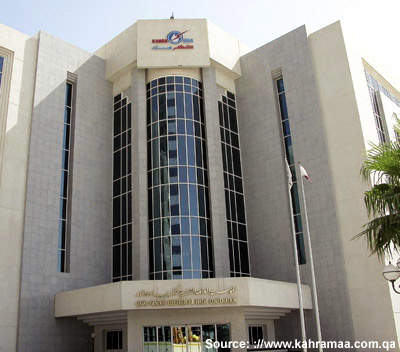
Kahramaa is a Qatari Shareholding Company of whose shares the Government owns around 43%, with 57% owned by companies and individuals. Kahramaa operates as an independent corporation on a commercial basis with a total capital of 4bn Qatari Riyals ($1.1bn). It owns and operates electricity and desalination facilities, electricity transmission and water distribution networks as well as performing network development.
