

The Hornsea 3 offshore wind farm is currently under development in the southern North Sea by Ørsted (previously DONG Energy Wind Power), a Danish multinational energy company.
The 2.9GW wind farm will be operated from Ørsted’s hub in Grimsby, UK. It will be the company’s third gigawatt-scale development in the Hornsea zone.
Recommended Buyers Guides

The main construction phase of the project started in May 2023, and the project is expected to be completed in 2027.
Upon completion, Hornsea 3 is expected to generate enough renewable electricity to power approximately 3.3 million homes in the UK, aligning with the UK Government’s target of achieving 50GW of offshore wind capacity by 2030.
The project will support up to 5,000 construction jobs, with an additional 1,200 permanent positions anticipated in the long operational phase, both directly and within the supply chain.
Hornsea 3 is expected to have an operational life of up to 15 years and will be a significant contributor to the UK’s renewable energy targets.
In December 2025, Ørsted completed the divestment of a 50% stake in the Hornsea 3 project to Apollo-managed funds for DKr39bn ($6.5bn). Apollo will gain a 50% stake in the project and also fund the construction costs.
Location of Hornsea 3
Hornsea 3 is located approximately 120km off the Norfolk coast and 160km off the Yorkshire coast in the UK, covering an area of approximately 696km2.
Development background of Hornsea 3
Ørsted submitted a development consent order application for Hornsea 3 in May 2018. Following acceptance in June 2018, the project received consent from the Department for Business, Energy and Industrial Strategy in December 2020.
A contract for difference (CfD) for the project was awarded to Ørsted in July 2022.
The preconstruction phase spanned from July 2022 to May 2023, focusing on onshore preparations.
The final investment decision (FID) on Hornsea 3 was announced in December 2023, setting the stage for the establishment of the world’s largest single offshore wind farm.
In September the same year, the UK Department for Energy Security and Net Zero granted Ørsted a CfD covering 1,080MW of capacity from Hornsea 3, alongside a separate 2,400MW agreement for Hornsea 4. The CfD for Hornsea 3 was awarded at an inflation-linked strike price of £54.23 per megawatt-hour (MWh).
Hornsea 3 project details
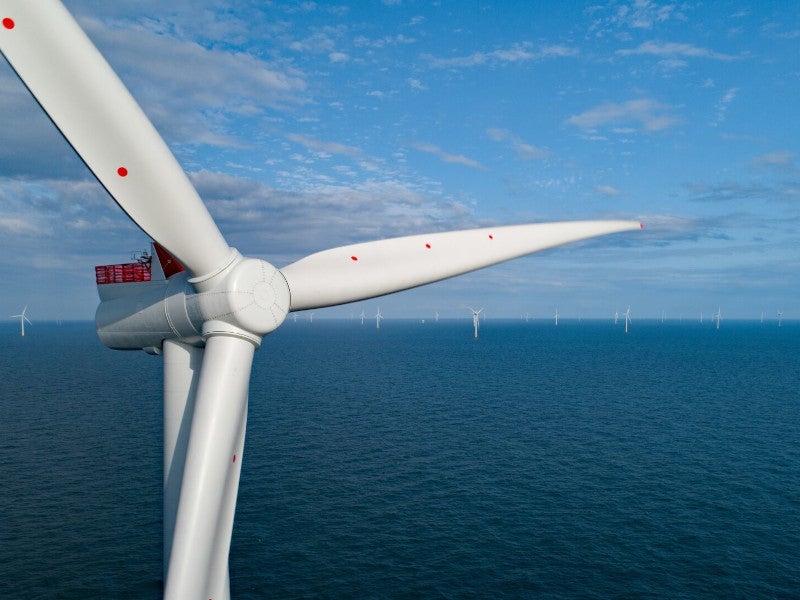
The Hornsea 3 offshore wind farm will be equipped with up to 231 units of SG 14-236 DD offshore wind turbines, each with a capacity of 14MW. The wind turbines will be installed across a 696km² area on XXL monopile foundations weighing between 1,300t and 2,400t and measuring between 83m and 111m in length.
The project will incorporate an HVDC Light® system, designed for efficient long-distance underwater power transmission, with notably compact converter stations and minimal electrical losses.
Hornsea 3 will be the first farm to utilise high-voltage, direct current (HVDC) technology in the Hornsea cluster, which includes Hornsea 1 and 2. The wind farm will include four HVDC converter stations, two offshore and two onshore, to manage power transmission between the wind turbines and the national grid.
The offshore converter platform will employ Hitachi Energy’s modular HVDC system, including the MACH™ advanced control and protection system.
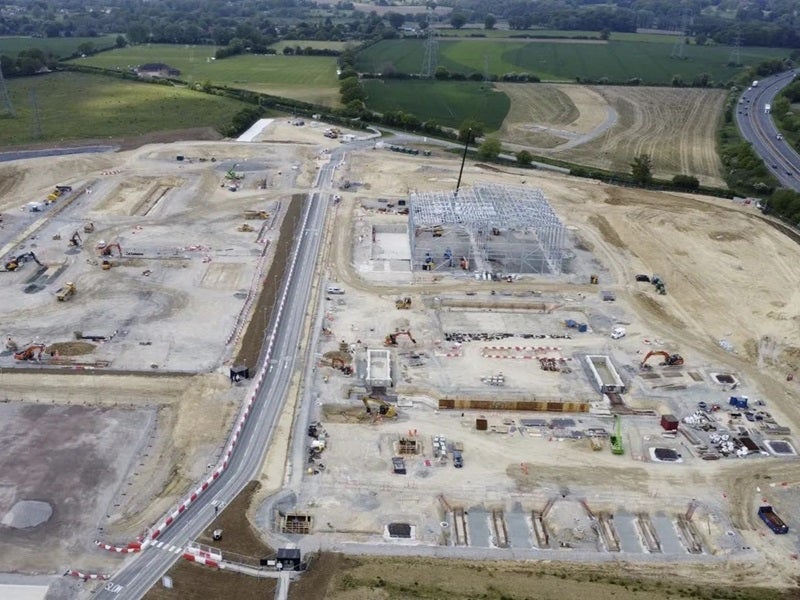
In June 2024, Ørsted took the FID on installing a 600MWh Tesla battery energy storage system located at Swardeston, near Norwich in Norfolk, alongside the onshore converter station for Hornsea 3.
Co-locating the battery with the converter station is intended to limit disruption for nearby residents and businesses. The storage system will be able to store enough energy to cover the daily electricity use of around 80,000 UK homes.
By storing surplus electricity when generation is high and releasing it later, the battery will support grid balancing and help reduce swings in consumer prices, particularly at times of peak demand. It is also expected to make the wider energy system easier to operate by smoothing fluctuations between supply and demand.
Turbine details
The SG 14-236 DD turbines will have a rotor diameter of 236m and a swept area of 43,500m², equivalent to around six standard football pitches.
The rotor and blades, based on IntegralBlade® technology, will enable the turbines to generate more than 30% more annual energy production compared to conventional models. The turbine has I, S IEC class, pitch-regulated, variable speed power control.
Hornsea 3 transmission details
The Hornsea 3 offshore wind farm will feature comprehensive transmission assets including offshore and onshore substations and extensive cable systems.
The onshore converter station will be located in Swardeston and will feed energy from Hornsea 3 into the UK national grid.
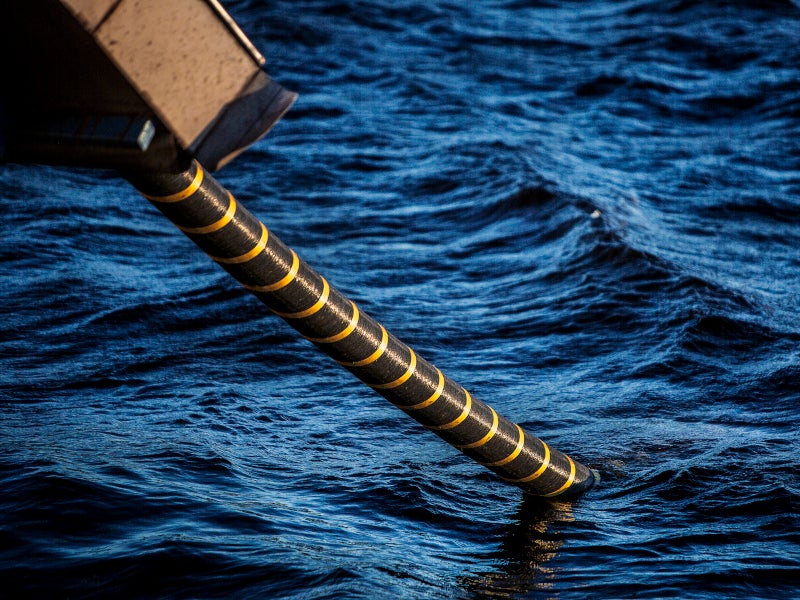
The transmission infrastructure will include 170km of 320kV direct current (DC) offshore cable and 50km of 320kV DC onshore cable, in addition to four 400kV alternating current (AC) onshore cable circuits spanning 1.5km in length.
The DC cables are designed to connect the wind turbines to the substations, while the AC cables will facilitate the connection between the substations and the national grid.
In total, up to 240km of cable installation will be undertaken, including the connection to the national grid. Post-installation, the project will focus on land reinstatement, involving tree and hedgerow planting.
The two HVDC export cables and an interlink cable will have a combined length of 350km, connecting the wind farm to the national electricity grid.
Contractors involved
The Jan De Nul Group, a dredging and marine construction services company, was contracted for offshore export cable installation in January 2024.
The Simon Stevin rock-installation vessel will be employed to lay up to 150,000t of rock for cable protection.
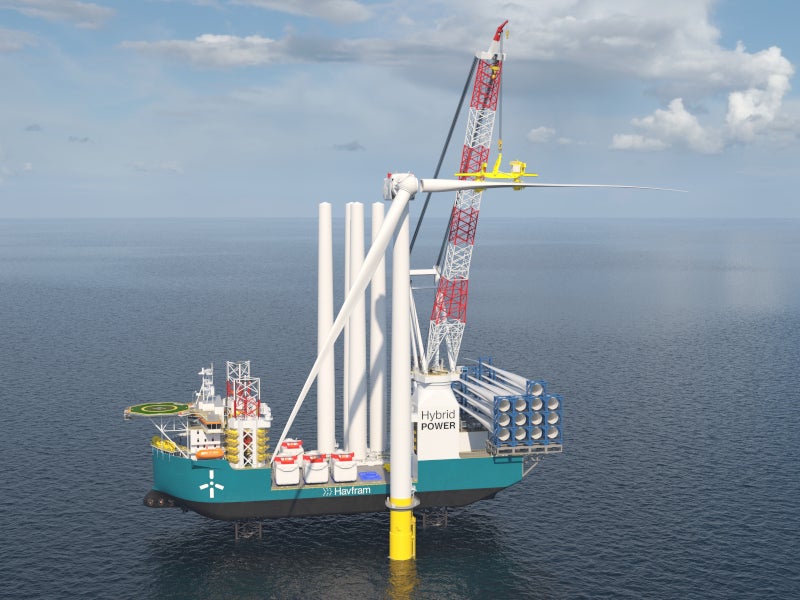
Havfram Wind, an offshore wind installation specialist and subsidiary of Havfram, was contracted in March 2023 for the wind turbine installation. The company will use an NG20000X Jack-Up Wind Turbine Installation vessel with a 3,250t crane.
In September 2022, Haizea Wind Group, through Haizea Bilbao, and SeAH Wind, a UK-based subsidiary of SeAH Steel Holdings, signed contracts for the fabrication of XXL monopile foundations.
Hitachi Energy, in partnership with Aibel, signed contracts in July 2022 to provide HVDC transmission systems and converter platforms for the wind farm. Aibel will deliver the two remotely operated and unmanned offshore converter platforms, while Hitachi Energy will supply two HVDC Light converter systems.
Denmark-based company NKT was awarded a contract in March 2023 for the HVDC export cable system, covering design, manufacturing, jointing and termination.
VolkerWessels, a multidisciplinary civil engineering and construction company, is responsible for the civil works associated with the cable installation.
Hellenic Cables, the cables division of Cenergy Holdings, and Prysmian Group were awarded separate contracts to supply inter-array cables in June and July of 2023, respectively. The two companies will be responsible for the design, manufacturing, supply, termination and testing of the cables that will connect the wind turbines to the offshore converter station.
Create, an engineering and environmental consultancy, and WSP, a leading engineering consultancy, are also contributing to the Hornsea 3 project.
Hutchinson Engineering, Severfield and Smulders, JDR Cable Systems and Seaway7 are some of the other contractors involved in the project.
