


The debate over artificial intelligence infrastructure has settled into an argument about money. Bulls point to hyperscaler capital expenditure guidance; bears point to depreciation schedules and ask whether the returns will arrive. Both are arguing about capital availability, and both are missing the constraint that determines the pace of delivery.
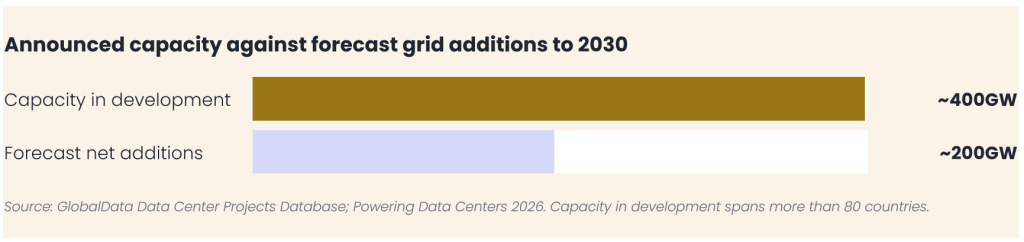
That constraint is electricity. GlobalData’s project database tracks data centre projects under development that would together draw around 400GW of power across more than 80 countries. Capacity here means the electrical load these facilities are built to draw when fully running in a year. Over the same period, GlobalData’s power forecasts expect the world’s installed data centre capacity to grow from about 100GW in 2024 to just under 300GW by 2030. In other words, the grid is expected to connect a little under 200GW of new capacity this decade, which is half of what has been announced.
The imbalance is sharpest in North America, which alone accounts for more than half of the global pipeline capacity.
Announced does not mean built
The obvious question is how long the extra projects will wait. The construction project records suggest the wait will be long and uneven. Some 71% of the data centre construction pipeline by value has not yet signed a construction contract, and around a third shows no sign of recent construction activity. Much of what has been announced is a long way from breaking ground, and some of it will slip well past 2030.
Even the capacity that does get built will not all be fully used. GlobalData forecasts that in 2030 the world’s data centres will be using only 59% of their installed capacity, partly because operators build ahead of demand and new facilities take time to fill. Put simply, roughly two-fifths of the capacity standing at the end of the decade is not expected to be fully utilised.
Nor can efficiency close the gap. Data centres are getting better at turning electricity into computing, but the improvement forecast to 2030 frees up less than a tenth of extra usable power, which is far too little to absorb a pipeline running at twice grid capacity.
Who wins and who waits
A data centre only starts paying its suppliers once it has power. That puts the companies easing the bottleneck — transformer and switchgear makers, grid connection specialists, on-site generation providers — in the strongest position, because demand for what they sell already exceeds what they can supply.
Companies that come later in the build, fit-out contractors and server suppliers among them, have to wait for projects to clear the bottleneck first, so a large, announced pipeline is worth less to them than it looks. And the first question worth asking of any individual project is whether the local grid has room for it, because that decides whether it opens anywhere near on time. The gap between what has been announced and what the grid can connect will not resolve evenly, so the practical question for anyone exposed to this market is which projects reach power first. GlobalData’s Data Center Projects Database tracks each of the roughly 2,500 developments in the pipeline, across more than 80 countries, from announcement to completion, while its Powering Data Centers 2026 forecasts model capacity and consumption market by market.
GlobalData’s free whitepaper, The Deliverability Gap, brings the two together, weighing every project by its stage and activity to estimate how much of the announced pipeline is genuinely deliverable by 2030, and what that means for the construction spending outlook. Download it below.
