

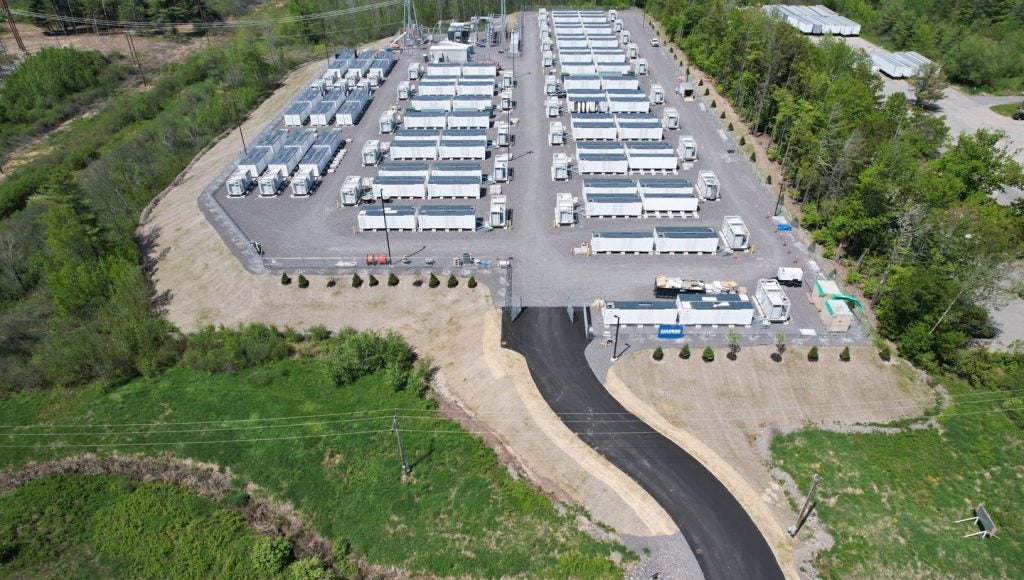
Plus Power has announced the commencement of operations at its 175MW/350 megawatt-hour (MWh) Cross Town Energy Storage facility in Gorham, Maine, US.
This utility-scale battery facility is designed to enhance the reliability of the regional grid. It captures surplus energy during periods of low customer demand and retains it for utilisation during peak demand times.
Consequently, it will assist in balancing intermittent energy sources, improving power reliability and efficiency, and alleviating energy price surges.
Plus Power’s facility aligns with the state's objective to implement 400MW of battery energy storage by 2030.
Projects like Cross Town also facilitate the integration of increased levels of variable renewable energy, supporting Maine's goal for 90% of its electricity sales to derive from renewable sources by 2030, and achieving 100% by 2040.
Situated on approximately five acres of land, Cross Town connects to Central Maine Power's 115kV Moshers substation, an area where the transmission grid experiences significant congestion.
The strategic location of the facility allows it to alleviate congestion and promote the utilisation of wind energy from northern Maine to meet demand in Boston and southern Maine.
Additionally, Cross Town will assist ISO (independent system operator) New England in compensating for the power capacity that will be lost due to the retirement of gas and other power plants.
Plus Power CEO Naveen Abraham said: “Plus Power is proud to operate another landmark facility in New England and further strengthen power reliability in the region. We look forward to continuing our partnership with ISO New England as our facilities demonstrate the unique capabilities of battery energy storage systems.”
The facility comprises 156 Sungrow PowerTitan battery storage system units.
Plus Power collaborated with Cianbro Corporation on the facility’s engineering, procurement and construction.
Cross Town is the company’s second storage project in New England. Its 150MW/300MWh Cranberry Point Energy Storage site in Massachusetts became operational in 2025.