


Gas-fired power plants play a central role in energy supply and a new whitepaper by Rolls-Royce reveals how carbon capture is fundamental to future operations.
Gas-fired power plants are flexible and controllable, independent of geographical conditions and can cope with fluctuations in the feed-in of renewable energies. As the world seeks to decarbonise, CCUS can help to reduce emissions while providing energy security.
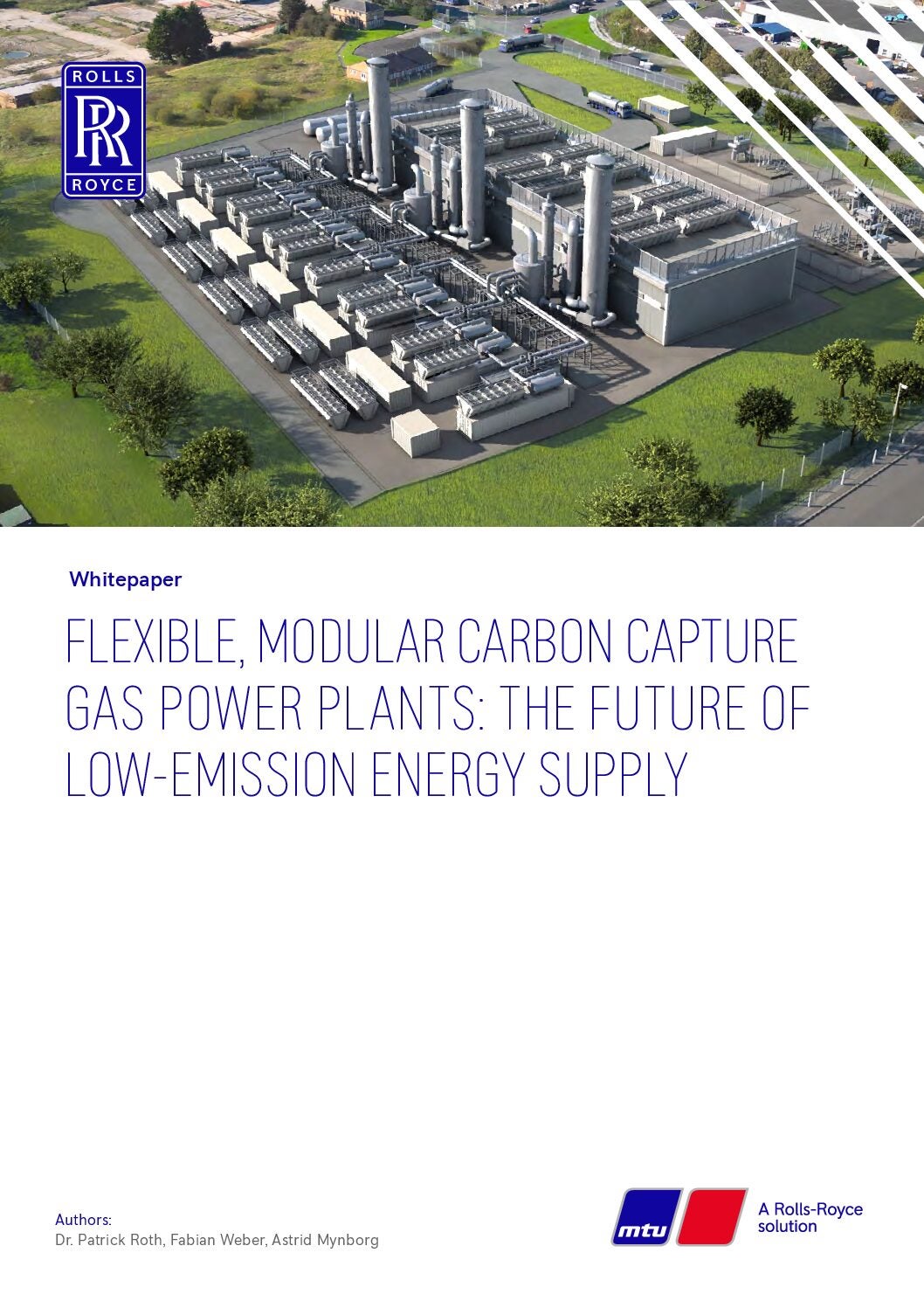
Titled Flexible, Modular Carbon Capture Gas Power Plants: The Future of Low-Emission Energy Supply, the whitepaper presents modular carbon capture solutions as a strategic advancement for low-emission power generation, with a particular focus on Landmark Power Holdings’ FLEXPOWER PLUS® concept which integrates CCUS technology provided by ASCO CARBONDIOXIDE LTD.
The study outlines the technical maturity of amine scrubbing compared to other capture technologies, the scalability of compact CCUS systems and the growing demand for low carbon, dispatchable energy. Alongside this, the whitepaper provides guidance on how to structure viable CCUS business cases by leveraging policy incentives, cost benchmarks and smart CO₂ utilisation across fuels, chemicals and building materials.
Global regulatory frameworks and funding mechanisms are also covered, including EU Innovation Fund support, US 45Q tax credits, and emerging legislation in China, Brazil, Germany and the UK. The whitepaper also highlights major CO₂ storage initiatives and international cooperation on cross-border transport, emphasising infrastructure readiness.
Global growth of CCUS technologies
Market forecasts indicate strong growth in engine-based CCUS capacity, reaching low gigawatt scale by 2030. Together, these insights position CCUS-enabled power generation as an important addition to the energy transition and a commercially attractive solution for future energy systems.
According to the IEA, more than 40 commercial carbon capture plants are currently operating worldwide, with a combined annual capture capacity exceeding 45 million tonnes.
Governments and industries are increasingly recognising the key role of CCUS technologies in achieving net-zero emissions targets. This shift is reflected in the growing political investment in research and development.
According to the IEA, CCUS could reduce global CO₂ emissions by almost 20% by 2050 while also lowering the overall cost of climate protection by 70%.
Carbon capture is the first step in the CCUS value chain. It is mainly used in ‘hard-to-abate’ industries, where CO2 emissions cannot be avoided. Several recovery technologies exist with different technology readiness levels (TRL). The whitepaper features a case study of the amine scrubbing method, which has the highest TRL.
Reducing the costs of carbon capture
One of the biggest challenges in CO₂ capture is the costs. A pilot project in Worksop (UK) addresses this through a circular economy approach, selling captured CO₂ under a long-term offtake agreement with Buse Gase Ltd, guaranteeing stable income and demonstrating a scalable business model.
Furthermore, the Worksop project demonstrates that CO₂ capture is more than a theoretical concept. The project is the first real-world application of the FLEXPOWER PLUS® concept, which combines modular power generation with integrated carbon capture, delivering 10MW of low carbon, flexible electricity.
This next-generation system is conceived as a standardised, rapidly deployable plant that provides low carbon and cost-effective power generation. The modular design facilitates swift market entry and adaptation to varied site conditions and production requirements.
Download the whitepaper below to learn more about how Landmark Power Holdings, in collaboration with Rolls-Royce and ASCO, is progressing a modular, containerised solution based on FLEXPOWER PLUS® technology.
