

The US low-carbon hydrogen market, once buoyed by billions of dollars in government backing under the Biden administration, now faces uncertainty as Donald Trump prepares to take office again.
Low-carbon hydrogen occupies an unusual political position. Green hydrogen, produced by electrolysing water using renewable electricity, offers a new source of demand for green energy industries. Blue hydrogen, produced from fossil fuels with emissions reduced via carbon capture and storage (CCS), could extend the role of the hydrocarbon industry into a lower-carbon energy market. The sector has thus won support from both traditional and clean energy interests, a fairly rare sighting in energy politics.
Go deeper with GlobalData


Discover B2B Marketing That Performs
Combine business intelligence and editorial excellence to reach engaged professionals across 36 leading media platforms.
This muddies the sector’s outlook under Trump, who campaigned on expanding oil and gas production while rolling back Biden-era clean energy policies that the hydrogen industry benefited from. However, those benefits have been weighted towards Republican-led states, offering a silver lining.
Hydrogen boom under Biden
The Biden administration sought to vitalise the nascent US low-carbon hydrogen industry through federal funding, tax incentives and a coordinated national road map.
The Infrastructure Investment and Jobs Act (IIJA) earmarked $9.5bn for low-carbon hydrogen initiatives, with the bulk allocated to developing seven regional hydrogen hubs. The landmark Inflation Reduction Act (IRA) introduced the 45V tax credit, which awarded up to $3/kg of low-carbon hydrogen produced.
These incentives were crucial in reducing levelised costs and making hydrogen projects more financially viable, positioning the US as “a key region for the global hydrogen market and something of a ‘land of carrots’ for prospective developers,” says Francesca Gregory, senior energy transition analyst at GlobalData.
The US has rapidly grown its project pipeline as a result, now placing third as the largest hydrogen market, behind only Canada and Australia. According to GlobalData, the country now holds 11.4 million tonnes per annum (mtpa) of active and upcoming hydrogen capacity, representing around 10% of the global share.
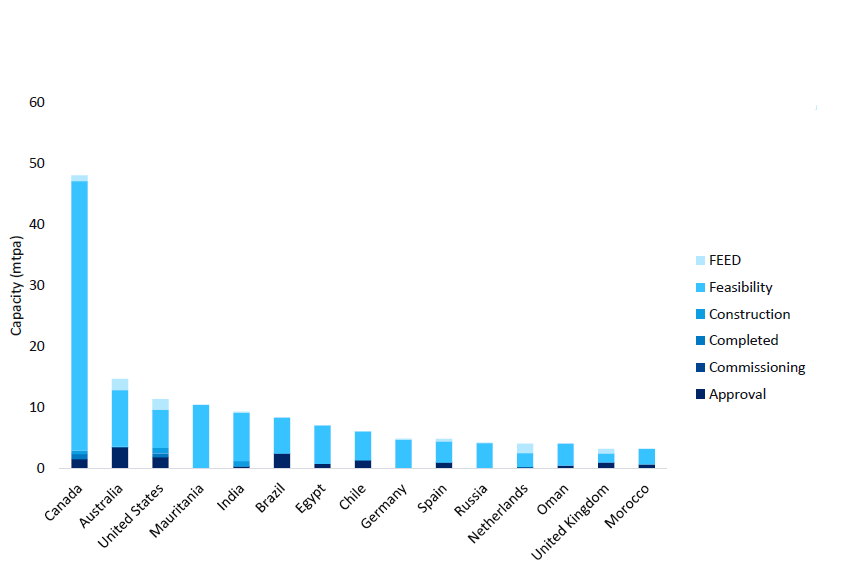
However, while these numbers look promising, feasibility and FEED (front-end engineering design) stage projects account for 44% of the total capacity outlook. With a large portion of the projects still in their infancy, the market remains vulnerable to policy shifts and financing conditions.
Hydrogen’s uncertain policy outlook
Although Trump has not specifically criticised hydrogen, he has made clear his disdain for the IRA’s clean energy incentives, frequently labelling them the “green new scam”. Gregory considers this “particularly alarming”, with many hydrogen developers counting on the 45V tax credit to offset high production costs.
A repeal or reduction of the credit could undermine market confidence and derail the current pipeline as early-stage projects, making up nearly half of the country’s capacity, may struggle to secure financing without it. The credit carries greater weight for green hydrogen, which remains more expensive to produce than its blue counterpart.
Gregory highlights that Trump’s broader agenda against renewables further jeopardises green hydrogen’s outlook. On his campaign trail, he vowed to slash IRA subsidies, grants and tax incentives for wind and solar projects, which in turn could alter the economics of developing green hydrogen. Prior to the election, GlobalData forecast US green hydrogen capacity to reach 3mtpa by 2030.
The prospects for blue hydrogen look less dire than for green hydrogen, given Trump’s support for CCS (in the context of expanding oil and gas activities). Yet with existing incentives placing both pathways under the same low-carbon umbrella, it is unclear how future policy will distinguish the two, or whether the approach will be all or nothing.
Red states could provide a lifeline
Nevertheless, a complete rollback of federal hydrogen support appears unlikely. As early as March 2024, the American Petroleum Institute, a major Republican party donor, argued that hydrogen incentives would survive a second Trump administration due to their popularity in Republican-led states.
The highest levels of hydrogen project activity are taking place in Republican strongholds such as Texas, Louisiana and West Virginia. Texas alone is home to 45 low-carbon hydrogen projects and far outpaces every other state in green hydrogen capacity.

These states stand to benefit significantly from preserved incentives, including the 45V credit.
Federal funding has also been distributed across the political spectrum. Of the 16 states hosting the regional hydrogen hubs selected under the IIJA, roughly half lean Republican.
These hubs will produce a mix of hydrogen types – some green, some blue and others even pink (hydrogen produced via electrolysis using nuclear energy). Notably, those taking the blue route are concentrated in right-leaning states.
The signs point to continued government backing for low-carbon hydrogen, though under Trump, not all hydrogen may be equal.
US risks losing momentum
As Trump’s policies take shape, the US hydrogen industry will undoubtedly face headwinds in one shape or form. But the widespread development of hydrogen projects in Republican-led states, coupled with the oil and gas industry’s support, hints that federal support could remain, at least partially, intact.
However, if the US is to maintain its market leadership on the global stage, support at current levels may not be enough. For one, the US only has a road map for its hydrogen sector, whereas other regions such as Canada, Australia and the EU have more concrete strategies in place to develop their respective markets.
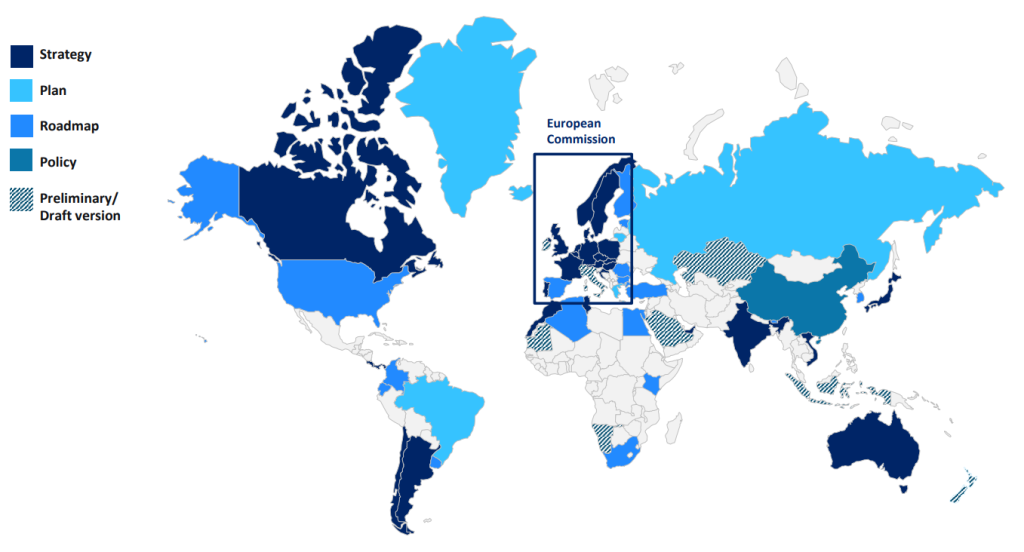
The National Clean Hydrogen Strategy and Roadmap, published under Biden in 2023, targets 10mtpa of low-carbon hydrogen production by 2030 to reach 50mtpa by 2050.
To avoid lagging behind, the US will need more than a project pipeline; developers will require predictable rules, financial stimulus as well as sufficient and consistent demand. This entails the Trump administration not just resuming but strengthening government support for the industry.
With strong state- and federal-level backing, hydrogen could still carve out a future in the US, even under a Trump presidency.


